



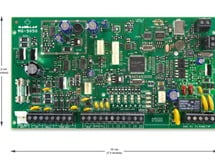

HOW much has changed in the world of
alarm panels? For many years there have been LCD screens and these and clever
onboard software solutions that make programming a breeze are probably the
major advance we’ve seen in domestic and small commercial solutions over the
past 2 decades.
There have been other changes. Some of
the latest generation wireless alarm systems take programming ease to a new
level with sensor devices registering themselves with the alarm panel with
little input from the installer. There’s also a new breed of outdoor sensors
with IP65 and IP66 ratings and the ability to handle outdoor installation as
part of a perimeter solution.
Fundamentally though, an alarm panel remains
a control board designed to power and monitor a series of NO/NC sensor loops
and to report NO/NC conditions as alarms at a local keypad and a remote
monitoring station via one or a combination of transmission technologies – most
commonly digital dialler.
We’ve panned dialler in Security
Electronics and Networks Magazine as offering low security while being too
expensive to poll in any meaningful way. But dialler’s inherent strengths and
longevity mean continued use. When it comes to alarm systems, it seems the
driving factors remain economy and reliability, along with dialler monitoring and
the too-easy rebates it delivers. Snazzy features offer better security but
they are a harder sell.
Line of defense
According to DAS’s Paul Knight, alarm
systems are still the engine room of any balanced security solution.
“They are the engine room, absolutely,”
he says. “They form a very important line of defense along with mechanical
locks, video surveillance, and manpower response. Alarm systems are still the key
component in a total security solution in that they alert authorities to an
incident.”
Knight agrees that alarm panels have
been technologically inert for some time.
“Apart from IP monitoring and the
inclusion of access control with some systems, alarm panel technology has been
quiet,” he says. “And while IP monitoring is an emerging technology and a
future technology, there will still be dialler alarm panels for some time.
“I see the critical factors with alarm
panels as ease of use and reliability,” Knight explains. “These along with
features that help prevent false activations like fire alarm verification and
zone twin trip.”
Knight says the sorts of systems that
are installed vary depending on where you are.
“Different markets around Australia have
varied trends,” he says. “In some states home builders include standard systems
with new homes usually comprising 3-4 movement sensors inside the home while
other states tend to install larger numbers of perimeter sensors.”
Knight says that both commercial and
domestic installations can benefit from correctly positioned external
detectors.
“The critical factors with alarm panels
are ease of use and reliability along with features that help prevent false
activations like fire alarm verification and zone twin trip” Paul Knight, DAS
“Obviously, placing a sensor in an
uncontrolled environment does deliver some challenging scenarios, and unknown
activations are still a concern for installers and system users.”
In terms of alarm system type, Knight’s
experience suggests hardwired solutions remain dominant with hybrids and full
wireless becoming more popular as prices of RF technology fall.
“Hybrid seems to be a popular choice,” Knight
says. “Installers are wiring what can be wired to reduce costs, and using
wireless where necessary. In terms of total numbers of systems installed, hardwired
systems are still ahead, but as wireless technology costs come down, sales of
wireless panels and sensors are increasing.
“Monitoring is definitely the driving
factor with alarm installations here in Australia, and I think commercial
monitoring numbers should remain relative stable, however, domestic monitoring
generally suffers in tight economic times.
“Installers and end users all basically
look for the same thing with their alarm systems,” Knight says. “They want ease
of use, reliability, competitive pricing and most importantly, back up support.”
User friendly
Bosch’s Adam Harris agrees that
monitoring is a key driver of alarm system installations but he puts it another
way. Harris says alarm systems are the engine room of a balanced security
solution because “intrusion control is the driver of response for monitoring”.
Harris says that while IP is the latest
trick, traditional reporting paths still hold sway.
“Sales of IP-enabled panels are low,” he
explains. “Most systems we sell are dialer-based. It’s true IP is the buzz word
and it will definitely have a place in the future, however, uptake to date is
low.”
Interestingly, Harris says that key
features of alarm systems are simplicity of operation as well as reliability
and stability. He has no hesitation in nominating easy interaction as being the
most important feature of an alarm system.
“A good alarm panel should be user
friendly,” he says. “Most users of alarm systems are not educated. An interface
which guides the user in operation of the control panel is important and will
greatly reduce false alarms due to user error – which is a significant source
of false alarms.
“Along with this, a 2400-baud modem is
important, with the local telecommunications networks struggling to support
legacy 300 baud dialers in many locations.”
Harris says Bosch has spent recent years
working on making operation easier for users and enhancing underlying
reliability.
“For some time we have been focused on
improving user interfaces and making them more intuitive for both installers
and end users,” he explains. “Our older designs have been updated for
compatibility with the current telecommunications network and soon all panels
we provide to market will feature a dedicated 2400-baud modem chip on board.
“Using a quality detector is very
important. The best intrusion control panel in the world will not go into alarm
without input from a detector. Similarly it will generally only false alarm as
a result of incorrect input from a detector” Harris, Bosch
“Without giving away too many secrets,
we will work to continue to improve user interfaces for both installers and end
users,” Harris says. “There is probably little room to improve footprints on
our system portfolio as there will still be terminals required for zones,
outputs, power etc and we already make significant use of multi-layer and
surface mount technologies in our designs. When it comes to system design, making
products more functional for both the installer and the end user is the key.”
In terms of the sorts of systems being
installed in the Australian alarms market, Harris says that both economy and
features are legitimate selling points.
“There will always be a position for
both economy and feature-rich products in the market,” he says. “Most
definitely customers are placing more emphasis on quality and support in their
purchasing decisions regardless of the product positioning in terms of price to
features.”
It’s easy to ignore the fact that
quality sensors are integral to the function of an alarm system and deploying
poorly designed sensors or installing quality sensors badly, can hamstring an
otherwise excellent alarm panel.
“Using a quality detector is very
important,” explains Harris. “The best intrusion control panel in the world
will not go into alarm without input from a detector. Similarly it will
generally only false alarm as a result of incorrect input from a detector.
“In many cases a quality detector will
have features that make it easier and quicker to install which will reduce
labor and start to offset the increased cost of purchase. When you add the
consideration that a single false alarm will cost more than the increased cost
in purchasing a quality detector, the use of quality detectors instantly becomes
cheaper overall.”
A long term trend in the alarms industry
is for project home builders to promote their homes as featuring an alarm
system and then to install a very basic solution with a couple of sensors that
cannot be used when the family is at home. Not only does this trend undermine
quality installers, it devalues the entire concept of domestic alarm systems.
“Many developers simply want to tick a
box on their offer to market,” says Harris. “What this means is that it does
not really matter if the system is 2 zones or 20 zones, the developer simply
promotes the fact a security system is provided.
“As the home purchaser is not educated
and likely more focused on the tiles; appliances, colours in the home, etc; the
alarm system is generally not going to feature highly on their list of
priorities.
“Definitely there is volume in domestic
construction, however, it is generally for entry systems,” Harris says. “There
are more up-market developments which do include the higher end domestic
products but these are the exception not the norm.
“Other drivers for domestic intrusion
control are renovations and monitoring is definitely still a driver,” he says.
“Conversely I think change of some description drives the commercial market –
this may be a change in tenant/owner of commercial premises, a change in focus
on security as a result of theft, or an independent audit or risk assessment.”
According to Harris, Bosch has plenty to
offer installers and end users, giving installers intuitive, reliable product
and users simplicity of operation and again, reliability.
“Bosch has a quality product backed by an
industry leading warranty and a highly regarded, global, consumer brand,” he
says.
“Our panels are all wireless-capable. Our
development of the user interface on our newer LCD control panels featuring graphic
displays with intuitive menus and the ability to provide common names to zones;
outputs, areas and schedules, ensures installers and their customers get an
advanced system that is simple to use and maintain.”
Features are king
Central Security Distribution is
distributing the Paradox range of alarm panels which boast a number of
interesting features that seek to take panel operation in new directions.
“Paradox has spent millions developing a
new range of panels that exceeds the demands and needs of integrators and
end-users,” says CSD’s Scott Hamilton. “The result is StayD panels which are
designed to allow perimeter protection day and night.
“When thinking about the best alarm
panels I would tend to move away from what is common,” he says. “Instead it’s what
is unique that defines the best panels and puts them above their competitors.
This means underlying quality features need to be created and improved upon.
“From CSD’s point of view right now that
differentiating feature is StayD, which is a development that allows a series
of perimeter zones to be set up on Paradox panels that will stay armed 24×7
even when the system has been disarmed by a user. This is an important
development that I think revolutionizes the perimeter protection capabilities
of alarm systems.
“An alarm system should be able to
provide protection to people as well as buildings and belongings,’ says Hamilton. “That’s the big
deal with StayD. The system is on when the family is home, it’s on when they’re
asleep and vulnerable. This system protects a large perimeter that can include
a pool gate or a garage or a workshop door. And StayD never forgets to arm the
perimeter or monitor high risk areas of the home, 24×7.
“Another key development CSD is offering
is Magellan, which is a wireless development from Paradox that offers more
functional and reliable solutions,” Hamilton says.
“What Magellan does is provide intelligent
2-way wireless with functionality delivered to remotes, as well as to keypads –
and that includes programming. Other strong features include menu-driven
programming to give integrators faster installs and flash upgrades across the
product range.”
At the same time he outlines these strengths,
Hamilton says that so far IP connectivity, the technological doyen of the day, is
being installed as a backup for monitoring of alarm panels but is not yet being
used widely as the main alarm comms path. But he says CSD expects and hopes this
will change rapidly.
“In terms of local communications we see
hybrid panels being a favorite,” Hamilton explains. “They offer everything in
one package and that allows for integrators to be flexible with customer needs and
site demands. There are also benefits in cost effectiveness to the integrator
and customer.”
Hamilton says that along with the new StayD,
Magellan and flash-upgradability, Paradox is also bringing out a din-rail panel
called the Imperial which will feature a wide range of expanders and
accessories and should hit the market later in the year.
“This panel will shock a lot of people
when it’s released,” Hamilton enthuses.
In terms of systems currently being sold
by CSD, Hamilton
says the majority are 4-8 zones hard wired but he points out that hybrid panels
are becoming increasingly popular.
“As for dialer, I think that needs to be
addressed, as most users have minimal polling because call costs are too high,”
he says.
Hamilton is
forthright on the subject of dialler polling and the way it cripples many alarm
systems through its hidden layer of monitoring fees.
“Look at the cost to the end-user,” he
says. “They are having to pay for every signal sent and that means monitoring
is too expensive to justify or alternatively, the panel is being programmed to
report once a week with no reports of openings and closings.
“Having a monitored alarm should be
about having every detail of when and who armed or disarmed the system,
including every zone alarm and restores, not to mention daily reporting of
system status. A home could be off-line for a week before anyone would know – what’s
the appeal in that?”
“We hope that IP reporting will be the solution
to non-polling of domestic alarm systems because it provides cost effectiveness
to end-users as well having the ability to give highly detailed reports,”
Hamilton says.
“This additional functionality potentially
means more monitored clients for the integrator, balancing out the income currently
generated by rebates.”