





“The
specification was to install an access control system that would suite the
client’s current basic requirement and also be upgradable in the future. In
short, they wanted a modular system that would integrate seamlessly with other
sub-systems in the future.”
INDUSTRIAL
applications demand capable access control solutions that can provide the right
balance of security and accountability. And for larger sites the ability to
establish who is on the site in the event of an emergency is also important.
Another vital feature on big sites with many doors and large numbers of staff
is ensuring that lost keys don’t demand huge outlays in re-keying when staff
leave, or credentials go astray.
The large, state-of-the-art
production plant on Viti Levu is a case in point. With well over 100 employees,
this is a mid-sized operation that demanded a real-time access control solution
with a proven track record and the ability to expand easily – not just with additional
access control but with video surveillance, should this be required.
According to ECS
International’s corporate service manager, Riz Akbar, the Pacific has been
traditionally seen as a soft target due to its relaxed life style. However, this
company has implemented a culture of security to protect its staff, facilities,
logistics and manufacturing process.
“As part of this
implementation, in 2003 ECS was engaged to train the company’s in-house
security team on security operations,” Akbar explains. “Importantly ECS
International is the only accredited TECOM installer in Fiji and when the issue
of access control came up it was natural that we should be involved.
“The access
control system was planned after several consultations with ECS International.
It was decided that it would be best to wait until their new storage warehouse
was completed before commencing the ACS project.
The company’s ACS
project manager (ACSPM) had clear requirements for the new access control
system.
“The
specification was to install an access control system that would suite the
client’s current basic requirement and also be upgradable in the future. “In
short, they wanted a modular system that would integrate seamlessly with other
sub-systems in the future.”
The ACSPM agrees.
“We wished to
implement a reputable system that was proven, tried and tested,” he says. “It
had to meet our current needs and should be easily expanded as required.”
The application
Akbar explains
that the purpose of the system ECS International installed is to control access
to sensitive administrative and manufacturing areas and keep records of
personnel movements in these areas.
“The system is
most easily understood as a centralised, electronic ‘master key issuing and
control system’, providing each ‘keyholder’ with a personalised smart ‘key’ and
an easy way to ‘re-key’ any or all of the ‘locks’ with a few mouse clicks,” he
says. “The system can also provide cardholder location information for building
evacuation purposes.”
According to Akbar,
in terms of scope, the system comprises 13 doors, 26 smart card readers and
around 180 cardholders with varying access control privileges. Doors include
single and double solid core doors with some being wooden and others aluminium.
Access control system
functionality is dictated to a significant extent by the features of the
management software driving the system. At this site, GE’s Titan Gold platform
has been deployed and is being used primarily to provide supervisor control of
cardholder access levels and retain records of system operation.
“Commercial
buildings in Fiji are traditionally constructed of high grade materials such as
reinforced structural concrete. It goes without saying that chasing through
this concrete required skill and persistence with careful attention to detail
in sensitive areas such as rooms which were designated dust free zones”
“Importantly, the
client had an existing photo ID card system and this was reproduced in the new
system with personalised IDs incorporating the client’s logo designed by ECS,”
Akbar explains. “Cards for the system were printed at our Suva office on the
ELVOIS ID Card Printer.”
Akbar says the
management software supplied by the manufacturer needed no customisation and
only a small amount of additional programming was required.
“The Titan Gold
software supplied by Direct Alarm Supplies provides control of almost every
aspect of the operation of the equipment,” he explains.
“Since this
installation used only a part of the available functionality of the equipment,
the supplied software was already able to provide the required functions. The
only additions were the database programming specific to the equipment’s
configuration.”
The equipment
also has the potential to integrate with video surveillance using a different
software solution.
“Titan Gold
allows for interfacing with the Challenger using a workstation,” Akbar says.
“There is an alternative product available from the supplier which provides
much greater functionality, including the ability to control substantially more
individual systems and control both DVRs and PTZ cameras.
“This could be
substituted for the existing system with little difficulty and is part of the
client’s access control expansion plan.”
The system
The access control
system which was installed included GE’s Challenger V8 and Titan Gold software,
supplied by Direct Alarm Supplies NSW branch. The power supplies and locking
devices (Capture 600-LED Maglocks and FSH FES20M electric strikes) came from
Seadan Security & Electronics in NSW.
According to
Akbar, all readers installed by ECS International are GE-supplied TECOM
Smartcard readers.
“Both electric
door strikes and electromagnetic locks (single and double door types) were
used. The controlling hardware consisted of a V8 Challenger Panel and several
Intelligent 4-Door Controllers,” Akbar says.
“The
comms/network infrastructure consisted only of the cabling necessary to connect
the various modules together – there were no network access points or patch
panels.
“The management
software is GE’s TITAN Gold (Single User),” says Akbar. “While this does have
the ability to alert an operator of any alarm condition, including invalid
access attempts, its primary purpose on this site is to provide a GUI for
controlling the access level of the issued smartcards and to store and access
the logging records.”
According to
Akbar, the system only controls cardholder access at this point in time but
vehicle access is controlled on other sites using similar equipment.
“It is envisaged
that Stage II of the ACS project will commence later this year and will
incorporate vehicle access management and pedestrian access through electronic
turnstiles,” he says.
Akbar explains
that while the system is relatively straightforward in design, the reader and
card technology used offers higher levels of security.
“The flexibility
and added security of smart cards was highlighted by ECS during the planning
stages and adapted in the specifications to suit this application,” he says.
“The TECOM product exceeded the specifications in this application.”
The installation
Akbar explains
the access control system is a fairly small installation, geographically, and
that had an impact on the system layout chosen.
“The Challenger
system utilises an RS-485 bus type LAN for module intercommunication, however,
for small systems a partial star configuration is allowed,” he explains.
“In this case,
the main system LAN was installed as a single bus but the reader connections
were configured as a star topology to provide redundant cabling for mutual
isolation of the readers and quicker fault finding in the event of a reader
failure.”
Akbar says that
while this is not a huge installation there were still challenges for the
installation team in Suva.
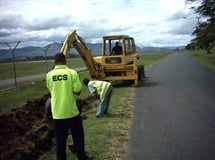
“Chasing of
existing concrete walls to install conduits for hiding cabling inside the walls
was a challenge,” he says. “Surface installation was out of the question and,
due to the adverse weather conditions such as tropical cyclones, commercial
buildings in Fiji are traditionally constructed of high grade materials such as
reinforced structural concrete.
“It goes without
saying that chasing through this concrete required skill and persistence with
careful attention to detail in sensitive areas such as rooms which were
designated as dust free zones,” Akbar explains.
“Conduits had to
be laid with sufficient bending radius to cater for future cables and service
work. Further, making-good with this installation had to be of an exceptional
standard in order to match the existing décor and this was all undertaken prior
to cable installation.”
There were other
challenges, too. Getting clean power was the big one.
“Clean and
constant power supply is a major issue that faces electronic installations in
Fiji,” says Akbar. “Power surges are a constant threat to the success of major
installations.
“Installers
accustomed to the stable operating conditions of larger industrialised
societies quickly learn that unless surge protectors and filters are fitted,
there will be damage to components often not covered by the manufacturer’s
warranty – this was a real concern.”
Akbar explains
that to counter this issue, the client had already installed essential power
redundancy for all its mission critical equipment which ensured that components
last their expected lifecycle.
For the ACS, all
remote equipment is powered from its associated controllers in the usual way.
“Locking devices
have individual power supplies and battery backups,” he explains. “All
controllers and power supplies are located in areas with power already
available.
“The ever present
threat of lightning strikes from tropical thunder storms dictates that ample
spares must be kept in stock locally – lightning is another big issue for the
client so that made it a big issue for us, too.”
According to
Akbar, the hardware installation covered 3 weeks and final commissioning
another week.
“Three employees
participated in this installation, one labourer, one technician, and the
assistant project manager who also conducted fit out, programming and ground
training,” he says.
“The installation
was carried out by local ECS technicians Anthony Titifanua (IRCFT) and Peter
Savukiono. Titifanua, who has received formal integration training in Sydney,
and Savukiono were responsible for all the fitout and programming.”
Akbar says no
support was required by ECS from the manufacturer or the distributor.
“Design,
installation and integration was completed using ECS staff,” he explains.
“Head-end equipment was supplied by DAS Alexandria and to our knowledge this
was the first TECOM installation in Fiji.
“DAS’s Alexandria
branch manager Ken Ruello shared our excitement and passion in winning a major
client such as this. This support was important because a key issue for ECS is
the fact there are no DAS branches in Fiji,” Akbar explains.
“This means
there’s nowhere to run if spares or new stock are required so supplier support
and parts availability back in Sydney really are vital to our success with such
critical projects.”
According to
Akbar, another key part of the installation process involved training of the
client’s staff.
“Operational and
technical training was provided by ECS’ local technical manager who had
attended a certified training program in Sydney,” he says. “The technical
training was successfully conducted for their system administrator.
“This training
included system configuration, user access management, basic troubleshooting
and administrator level controls over the system,” he explains.
Akbar says that
initially cardholders were not familiar with the anti-passback system which
required users to register their cards at the door exit readers so that the
system was aware they had left the controlled area and this caused a few
hiccups.
“Once the users
became familiar with the new anti-passback protocol, no further general usage
problems arose. All in all, the training was a success,” he says.
The results
Now the system
has been installed and commissioned, Akbar says that security onsite is
demonstrably improved.
“The security
officers can now authenticate who is allowed onsite and the system ensures that
only authorised persons are permitted to access sensitive areas,” he says. “Any
complacency about the system was quickly arrested by that anti-passback feature
– the ACS is now taken seriously.
“The system fully
meets the design criteria by providing controlled access to various sensitive
areas and logging records of all cardholder’s access and current location.”
Akbar says he is
extremely proud of the young local team that carried out the installation and
commissioning in Suva.
“This is a
reflection of our local expertise and it’s a plus for Fiji’s economy, which has
been suffering from a lack of skilled labour due to migration,” Akbar explains.
“While other
companies have refrained from investing in an uncertain overseas environment,
ECS took this challenge head-on and believed in giving opportunities to local
young technicians, allowing them to develop their electronic security skills.”
“From the perspective
of ECS International it’s been a very pleasing result,” he says.
*Company
details relating to this installation withheld for security reasons