



What Could Be Causing Our IP Camera Fault In SEN’s Opinion – Is It The Camera Or The Network?
What Could Be Causing Our IP Camera Fault – We have a customer who is having mild issues with a single IP camera installed on an external wall in a remote corner of a large site.
The camera is monitoring a side entrance and is connected by Cat-6 cable to a local network switch, linked back to the administration office on the site’s backbone.
The issue is that this camera has become unreliable. It’s not the end of the world but it regularly drops offline for several seconds before reconnecting and occasionally reboots completely. The problem is worse at night when the camera switches to IR illumination for some reason. Other cameras connected to the same system are operating normally.
Something we have tried is swapping out the camera but that doesn’t resolve the problem. What could be causing the issue and how could it be resolved?
A: Intermittent loss of the camera at the VMS with entertaining behaviours like link dropping and reconnecting, occasional camera rebooting and increased instability when IR illumination increases the camera’s PoE load sounds to us like a ground potential issue.
A cable tester may show the Cat 6 pairs are correctly terminated, making the problem less obvious but the most like cause is a ground potential difference at the remote camera location creating an unwanted current path through the cabling.
This sort of behaviour is more likely if shielded cabling, grounded equipment or metal mounting infrastructure is involved, though you don’t mention this. Alternatively, these symptoms could indicate a PoE or cabling fault, so the presence of a ground loop will need to be confirmed in the field.
Reading the symptoms
Four clues, one pattern
No single symptom is conclusive. Together they point away from the camera and towards the path it sits on.
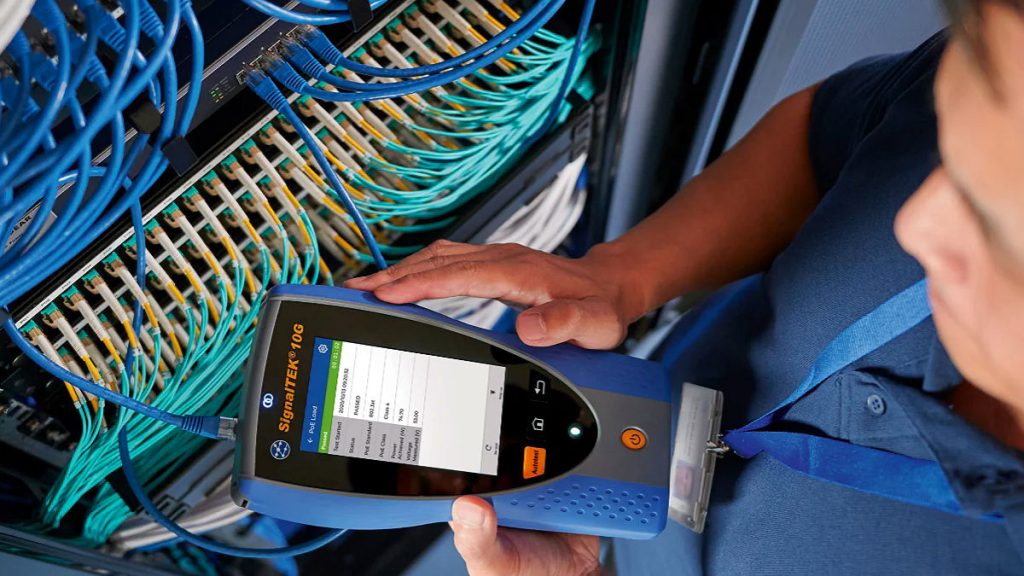
We’d test the Cat-6 run, check PoE voltage and load, and measure for a potential difference between the remote equipment earth/chassis and the local network earth. While you’re at it go ahead and check cable shielding, terminations, bonding and any surge protection – any external camera should have protection, but too many don’t.
Why the location matters
Two earth references, one metallic path between them
Toggle to see what a fibre run changes.
The point: nothing is wrong with the camera, the switch or the cable in isolation. The fault is created by joining two places that sit at different electrical references with a conductor. Fibre is the last resort, not the first — correcting bonding and earthing comes first.
If a ground potential difference is confirmed, we’d suggest correcting bonding/earthing rather than disconnecting protective earth. If the remote location can’t share the same electrical reference, replace the copper network run with between remote switch and admin. This will provide galvanic isolation between the remote camera and the admin building. The camera can then remain connected to the local PoE switch by a short Cat 6 run.
You can find some network cable testers and capabilities here or read more SEN news here.
Related questions
Ground loops and PoE cameras
Why does my IP camera only drop out at night?
IR illumination is the heaviest load a camera places on its PoE supply. If drop-outs follow the illuminator rather than the clock, the fault is load-dependent — typically a marginal PoE supply, a cabling fault, or a ground potential difference that becomes disruptive as current rises.
My cable tester passed the run. Does that rule out the cabling?
No. A tester confirming correctly terminated pairs is exactly what makes this class of fault hard to find. It verifies the pairs, not the electrical environment the cable passes through, and it does not detect a potential difference between the equipment at each end.
What is a ground potential difference on a camera network?
It is a voltage difference between the earth references at two locations. When a metallic cable joins them, that difference drives an unwanted current through the cabling. On a camera link it shows up as intermittent drop-outs, spontaneous reboots and instability that worsens with load.
Can I fix a ground loop by disconnecting the earth?
No. Lifting a protective earth may remove the symptom, but it leaves a real safety hazard in place. The correct remedies are to correct bonding and earthing so both ends share a reference, or to remove the metallic path between them.
How does fibre stop a ground loop?
Fibre carries no current, so replacing the copper run between the remote switch and the head end galvanically isolates the two locations. The potential difference may still exist, but it no longer has a conductive path to travel along. The camera can remain on a short copper run to its local PoE switch.
Why is only one camera affected when the others are fine?
Because the fault belongs to the location, not the equipment. Cameras sharing a switch, a backbone and a VMS with the faulty one are working, which points at what is unique about that one run — a remote external position likely to have picked up a second earth reference.
“What Could Be Causing Our IP Camera Fault In SEN’s Opinion – Is It The Camera Or The Network?”