




IF anyone was going to successfully apply
megapixel technology to networked PTZ cameras it was going to be Axis
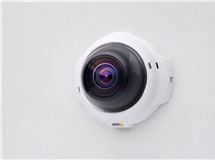
Communications. The company’s new 212 PTZ and 212 PTZ-V networked dome cameras
are designed to offer greatest operational simplicity and reliability while
enhancing surveillance functionality. This is achieved by using a 3-megapixel
sensor and a wide angle lens to give a constant 140-degree field of view.
The big deal here is that traditional CCD
and CMOS-based network cameras can only view a small part of the scene at a
time and that means while a PTZ may get good images of a specific target area,
the rest of the scene will be completely out of focus. This may not be such an
issue if there’s a manned control room but in most applications PTZs are
generally fixed on a hotspot or set to tour – that means what you record is
what you get in terms of field of view and depth of field.
Going megapixel does away with all this –
you get the whole scene to significant depth all the time and when you move the
‘PTZ’ around the scene on an authorised computer, you’re moving around the
entire scene from edge to edge. Because the camera is delivering the entire
scene to the operator there’s no latency in PTZ operations. You use mouse
clicks to zoom and pan and each action takes place instantly. A security
officer or system operator can zoom just by clicking on an area of the image.
In terms of performance specs, the cameras’
feature 3x zoom, claimed minimum scene illuminations of 10 lux on wide angle
and 20 lux in tele mode, 9 resolution options with a peak of 640 x 480, 100
compression levels, MJPEG and MPEG-4 streaming at 30 images per second and 20
preset positions.
The 212 PTZ and 212 PTZ-V are not meant to compete
with super high res analog speed domes – Axis Communications has built these
cameras with extreme functionality instead of extreme performance. Install one
Axis 212 PTZ in a retail outlet or hotel lobby and you’ll in a position to view
the entire scene in high resolution, and, if you choose, to record that entire
scene leaving nothing out.
Pretty obviously, the core of the 212 PTZ
is that 3-megapixel sensor but that’s not all there is to the equation. While
most cameras have a 180/360 degree format and lose a portion of their
resolution to areas of the scene that may be of no interest, the 212 PTZ’s
140-degree field of view is designed to fit in a typical monitor with the
additional pixels to a total of 2048 x 1536 crammed into the relevant
area.
Another attribute of this camera is that it
employs its sensor to achieve oversampling so that whether you’re looking at
the entire scene or looking at 3x digital zoom you’re still enjoying full VGA
resolution of 640 x 480 pixels.
The 212 PTZ and PTZ-V give users everything
they’d want in a network camera. There’s PoE for simplified installation and
easy UPS support, while the lack of moving parts improves reliability, reduces
opportunity for tamper and cuts power demands. There’s also simultaneous MPEG-4
and Motion JPEG video streams in order to deliver a combination of highest
possible quality and best possible bandwidth options. Bandwidth maximisation is
also enhanced by the cameras’ ability to window a specific portion of the
sensor grid, the result being that you’re getting only what you want at maximum
resolution and not clogging up the network with an image stream that’s half
irrelevant.
There are also a range of integrated
functions like pre and post-alarm buffering (5 minutes, 320 x 240 pixels, 4
frames per second), video motion detection, scheduled and triggered event
functionality with alarm notification. Built-in 2-way audio support allows
remote users to view, listen and communicate. Importantly up to 20 users can
access either of these cameras simultaneously.
From an operational perspective, the 212
PTZ and PTZ-V can be accessed by an authorised user from any networked computer
in the world. You interface with a camera through AXIS Camera Station video
management software which allows remote video monitoring, recording and
playback. The cameras also allow the programming of event management with
multi-window motion detection, audio detection and an I/O for connection of
devices like external relays and sensors to activate lights or close doors.
If you want to integrate these AXIS cameras
you use the VAPIX application programming interface to build customised
applications.
And if you’re in any doubt that Axis
Communications is an IT company, the broader specifications provide a hint.
Network utilisation is enhanced by support for QoS – which allows a CCTV application
to reserve network capacity and priority on QoS aware networks. And the cameras’
support IPv6 as well as IPv4. Providing security are multiple passwords linked
to user access levels and there’s address filtering, HTTPS encryption and IEEE
802.1X network access control.
The Axis 212 PTZ and 212 PTZ-V cameras are
designed to function effectively across a range of network environments and
they’re supported by core functionality that makes them perfect for many
applications, particularly those with large fields and view and depths of field
including retail, hospitality and educational facilities.