




THERE are a
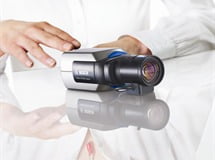
couple of good reasons to take notice of the new Bosch Dinion 2X. The first is
that with Dinion 2X, Bosch is acknowledging how important to its revenues
analogue cameras will continue to be in the medium term. The second reason is
that the new Dinion 2X is a superb surveillance camera.
So – what are the
specifications of Bosch’s latest release? Run your eye over this camera’s spec
sheet and what’s immediately apparent is that the Dinion 2X has an enormous
amount of processing power – 32x more processing power than the original 15-bit
Dinion. The other interesting thing about the new Dinion 2X is that the camera
offers 540 lines horizontal resolution, same as the 15-bit Dinion. This is an
issue we’re going to come back to but clearly Bosch has decided to focus its
effort on processing and not on resolution.
Other standout
features of the camera include a CCD sensor manufactured to Bosch’s own design
to enhance wide dynamic range and a dynamic processing engine with Smart BLC.
There’s also day/night mode, privacy masking, default shutter, lens wizard,
Bilinx comms with cameras installed anywhere along a cable run, 76 programmable
operating modes and video motion detection.
Dynamic range is
excellent at 120dB and there’s a sharpness enhancement selection capability and
onboard cable compensation for cable runs of 1000 metres without external
amplifiers. That last is a really valuable feature. Typical of Bosch, too, is
an onboard test pattern generator that ensures installers can make sure
installations are put together properly, with all hardware functioning as it
should. Having a test pattern generator onboard the camera is pretty neat and
it works extremely well. You can check colour bars to 100 per cent, 11-step
greyscale, Sawtooth 2H, Checker Board, Cross Hatch and UV plane.
I got a first
look at the Dinion 2X at Bosch’s Huntingwood HQ where a couple of untweaked
cameras, the new 20-bit Dinion 2X and the current 15-bit Dinion camera were set
up and linked to the same standard CRT monitor. As well as having the ability
to adjust light levels in the room the way the test bench was arranged allowed
the introduction of some nasty backlight by opening doors and blinds.
In terms of
housings, the unit comes as a Flexidome or a full bodied camera and the camera
we were playing with was the full bodied unit. It was immediately apparent that
the new camera is a big step forward. There’s increased clarity in all parts of
a scene – it’s significant. The increased clarity is such that there’s
significantly greater visible detail. With Dinion 2X, the small details really
spring to life.
We tormented the
camera by varying the inside and outside light while seeking a useable view in
both parts of the scene and the 2X easily out-performed the 15-bit Dinion which
was doing a good job in its own right.
Next, we test the
2 cameras with inside light very low and outside light very bright with a
subject standing in the gloom. This is a very difficult shot to get right but
the Dinion 2X manages it nicely. There is distinctly more detail – right down
to tie stripes, shirt creases and facial lines.
Given the
challenge of the situation, performance is exemplary. According to Bosch’s Sean
Borg, the new camera is significantly better than the old one.
“The Dinion 2X is
a great improvement which is big call considering the capability of the
existing Dinion technology,” Borg says.
“The new Dinion
2X processor is 32x more powerful in terms of processing, than its predecessor
and that makes a massive difference to this camera’s imaging capability.
“The key to
Dinion 2X is image quality – not resolution,” he explains.
“It doesn’t
matter how high the resolution is if the camera is not designed to handle the
conditions. Resolution is not the be-all and end-all – what’s important is being
able to see and identify. There is no point having high resolution if your
camera can’t use it.”
“We tormented the
camera by varying the inside and outside light while seeking a useable view in
both parts of the scene and the 2X easily out-performed the 15-bit Dinion which
was doing a good job in its own right”
Borg’s position
makes perfect sense when you sitting in front of the camera views, challenging
the camera with silly amounts of backlight and adjusting the light levels in
the foreground. There is far greater clarity in the scene and a noticeable
increase in sharpness.
All that extra
processing power gives this unit the ability to handle situations other cameras
battle with, including the management of dual exposure.
“The Dinion 2X
has a 10-millisecond and a .06-millisecond exposure,” says Borg. “The 10
millisecond exposure is the long exposure that gets the dark areas lit up
nicely while the shorter exposure allows the camera to pick up what’s outside –
ideal when there’s extreme backlight.
“And because of
this camera’s additional processing power we can use our wide dynamic function
as well as our dual exposure at the same time, which is a really big deal in
surveillance applications.
“When you break
it down what we are doing is taking a long exposure in 16-bit step sizes and a
short exposure in 4-bit step sizes with each image being interlaced after
capture,” he explains. “The result of the extra processing is that you can see
more in harsh lighting conditions.”
What Borg says is
true. Dual exposures create a major challenge for cameras, particularly in
scenes where there are still and moving parts.
“When you’re
giving extra exposure time to defeat backlight it’s important that this does
not introduce problems like blurring in moving parts of the scene,” Borg says.
“With the Dinion
2X we get a nice still shot that handles backlight and movement.”
To illustrate
this point, Borg shows me a pair images which compare the Dinion 2X to another
leading camera. The shots are taken either in the evening and include tall
buildings at a distance, with side light, long shadows and in mid-scene, a bird
flying by. The difference in the shots is readily apparent with the Dinion 2X
doing a far better job of detail at a distance, light and colour rendition,
general clarity and sharpness. But the telling
point though, is the bird. The Dinion 2X shows this clearly while the
competitor’s camera shows only a smudge.
“The Bosch camera
has a default shutter speed operating at the same time as the smart BLC and
this gives a perfect image when faced with challenges like this,” says Borg.
“I don’t think
the technical challenges of dual shutter speeds are appreciated by the market.
While we now have a fast shutter speed and a slow shutter speed – same as some
of our competitors – the fact we’ve got a 20-bit processor means we are able to
employ these capabilities without any artefacts being generated,” Borg
explains.
“We’re also able
to have that technology without this impacting on our wide dynamic range or our
default shutter speed. Another strong feature is dynamic noise reduction – we
sample the pictures to clear the dynamic noise like AGC out of the picture.
“This is doubly
helpful because not only are images superior, it means AGC noise is not stored
on valuable hard drive space – this is a major problem – these P frames can
mean the file sizes are much more.”
Ease of
installation
Borg says he
estimates the performance improvement makes the new camera at least 30 per cent
sharper than the 15-bit Dinion. But he says there’s more to the story than
meets the eye.
“With the 15-bit
Dinion XF, I had to set up the back light compensation – that’s what you do
with anybody’s camera. You have to set up the box and you have to set it up in
the right size relative to the image that is going to stand in front of it,” he
explains.
“But I didn’t do
any setup with the Dinion 2X – that image we are looking at is straight out of
the box. This camera senses the bright spots and sorts out backlight it all by itself
as part of Dinion 2X’s smart backlight compensation.”
This means very
simple installation and ease of installation is assisted further by the Dinion
2X’s simple menu system.
“We have a
standard menu and an installation menu,” Borg says. “With the install menu we
have 6 pre-program modes but you can install the camera straight out of the box
if you like.
“There’s a a
24-hour mode, a low light mode, a traffic mode for high speed, a smart BLC mode
for extreme backlight like the front door of services stations or stores, and
others.”
Borg says a
feature he’s particularly happy with is the test pattern generator.
“With no effort
during installation installers can use the onboard test pattern generator to
make sure the commission process is perfect,” he says.
“It’s all so
easy. If you have not got 11 grey scales then there’s something wrong with the
DVR, if the red is bleeding into the pink, there’s something wrong with the
DVR, if you’re getting high frequency roll-off you’ll see the softer images on
the checkerboard,” he says.
“The idea is to
give the best quality image as quickly as possible to get techs through the job
and off the site as quickly as possible,” Borg says.
“There is a real
nice feature called Peak White Inversion – if you’ve got some bright lights
around the place you can press PWI and it will turn them light grey – it’s
great.
“Our camera is
one of the fastest to backfocus – most you have to pull the camera out of the
housing to unlock the backfocus – screwdriver does not fit, apply ND filters
and call it in.”
Borg says that
with the Dinion 2X you access the auto wizard, unlock the backfocus with one finger
which opens the iris completely and then you can backfocus the camera without
pulling the camera out.
“Commissioning is
much faster – installers don’t have to go to the camera – you can do it over
the network or the coax,” he explains. “Backlight set-up costs are reduced –
you don’t have to set up backlight – with other cameras it’s 2 people. With our
old camera one could do it – but with the 2X it’s automatic.
“And many people
forget to line-lock – it used to be important to stop vertical roll on switchers
and it still needs to be done or you cannot assure a set frame rate,” he says.
“If one camera is
ahead of another there will be a one
cycle waiting period before the vertical integral pulse comes into line – the
rate might be a couple of frames slow.”
According to
Borg, with other cameras you have to line-lock with someone at the camera and
someone at the DVR.
“With our 15-bit
Dinion a single person could line-lock but the new Dinion 2X does line-lock
automatically – all up I estimate you can save 60-70 per cent in time
installing the Dinion 2X – it’s that good.”
There’s a lot of
value built into the Dinion 2X – Bosch offers a 3-year warranty but the cameras
have a 21-year mean time between failure.
Then there are
features like the cable compensation amplifier. Having this amp built in saves $100
on hardware, discounting installation costs.
The new Dinion 2X
is a strong contender in real world applications. It combines awesome new
processing capability with practical features that streamline installation in
ways no other analogue camera does. Best of all, despite the increased
capabilities, the price of the Dinion 2X remains the same as the current
technology – that’s very appealing indeed.