




THIS month we
will carry out basic objective tests on the Bosch LTC 0489 Dinion 2X Day/Night
camera. It uses a 1/3-inch, wide dynamic range CCD sensor and incorporates
advanced 20-bit digital signal processing for improved picture performance and
the 2X-Dynamic technology extends the image dynamic range.
Our analogue CCTV
camera tests will comply with the European Standard EN 61146-1 Video Cameras
(PAL/SECAM/NTSC) – Methods of measurement – Part 1: Non-broadcast single-sensor
cameras. This standard is also known as IEC 1146-1 and BS EN 61146-1 and is
accepted world wide as the preferred method of testing single chip CCTV cameras
and it is suitable and preferred for all current colour or monochrome single
chip cameras.
The camera
Valued features
of the Bosch LTC 0489 Dinion 2X Day/Night camera include:
* Detail in
Extreme Lighting: In some lighting conditions, the difference between the
brightest and the darkest parts of a scene can be extreme. The Dinion 2X
generates two images; one long exposure to resolve details in the scene’s
darkest areas, and one short exposure to resolve details in the scene’s
brightest areas. The Digital Signal Processor (DSP) combines these dual shutter
images, from each exposure to produce the most suitable image.
* 20-bit Image
Processing: The digital signal processing optimally captures the detail in both
bright highlights and deep shadows simultaneously. By combining 20-bit image
processing the Dinion 2X maximizes the information visible in the picture even
with strong backlighting.
* Wide Dynamic
Range: The 2X-Dynamic and SmartBLC, using 2X-Dynamic technology, pixel-by-pixel
analysis provides the user with detailed image information and SmartBLC is used
to automatically compensate the image without the need for any set-up.
* Lens Wizard:
The Dinion 2X camera auto detects the lens type (manual iris, DC iris, video
iris) or it can set manually. The lens wizard can be used to back focus the
lens with maximum iris opening so the lens will maintain focus through all
lighting conditions over a 24 hour period.
* Cable
Compensation: The cameras include built in and menu controlled cable
compensation which eliminates the need for an additional equalising amplifier
on long coaxial cable runs. The cable compensation can be switched off, or set
for various equalising levels and can be adjusted over a wide range.
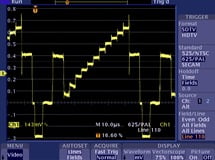
Our tests showed
that there is a degree of cable compensation even when the cable compensation
is switched off. This can add overshoot and undershoot to the video signal with
very short cable runs as can be seen on the waveform images. Our tests suggest
Bosch has set the off position cable compensation to suit coaxial cable runs of
about 100 metres, which is about average.
The overshoot and
undershoot from this camera is very clean and does not detract from the viewed
image but is noticeable when the camera is connected via 1.5 metres of coaxial
cable to sensitive test equipment.
It is interesting
to note that the European Standard EN 61146-1 Video Cameras (PAL/SECAM/NTSC) –
Methods of measurement – Part 1: Non-broadcast single-sensor cameras state the
following in a footnote for the overshoot and undershoot tests: “To improve the
apparent sharpness of the visible picture, some cameras may produce an
overshoot at the edge of a bar signal. Taking this into account, it should be
noted that a smaller amplitude of overshoot and undershoot does not necessarily
indicate better picture quality”.
The tests
This series of
tests shows the camera test chart with a yellow marker showing the approximate
position of measurement on the camera test chart in relation to the waveform
image. This will assist those who are interested in the test chart position
these test measurements are made.
The tests were
carried out on this camera with its default (out of the box) settings, except
for the lens wizard, which was set for a manual lens to suit our high
performance Schneider test lens.
The sensitivity
according to EN 61146-1 standard for the Bosch LTC 0489 Dinion 2X Day/Night
camera was found to be 4.6 lux. This figure is normal with most cameras because
sensitivity test references and standards are rarely quoted by manufacturers
these days. We also noted that the day to night changeover happened at 16 lux which
is according to the EN 61146-1 standard.
The resolution
was 520 TV lines which is close to that specified by Bosch. The waveform image
shows a depth of modulation of about 15 per cent at 520 TV lines which is three
times more than the 5 per cent depth of modulation specified in EN 61146-1.
(Note: The tested figure of 520 TVL against the Bosch specified 540 TVL may be
explained by our method of splitting the Luminance (Y) and Chrominance (C)
signals for our measurements, rather than relating to camera performance, or the
performance of our high quality Schneider test lens).
We found the
greyscale of this camera to be well within specification and more linear than
many we have tested. We did note some black stretch which improved black
detail. We included an image and waveform of the overshoot mentioned above.
This apparently complies with the EN 61146-1 standard and improves the apparent
resolution to the eye viewing a CCTV monitor over a normal coaxial cable
length.
In the next issue
we will test another top preforming analogue camera and in a separate article
compare its back light performance with the Bosch LTC 0489 Dinion 2X Day/Night
camera and then, in the months following, test several selected new technology,
high performance IP cameras.
*Les Simmonds is an independent CCTV consultant.
Email: les@cctvconsultants.com.au