





EVEN waist deep in road work and unbalanced by the
paraphernalia of major construction, Canberra’s
National Gallery of Australia
is a thrilling structure. The strength and subtlety of the exterior is matched
by an interior combining bush hammered concrete and honeycomb-delicate
ceilings.
At NGA, space leads into space, ceilings soar 20 and 30
metres and voids pour sound and light though three levels. This building is a
work of art and its design and role as Australia’s pre-eminent art gallery
make NGA one of the nation’s more challenging sites.
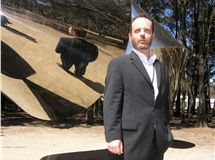
Manager for security at NGA, Craig O’Sullivan, is
ex-Australian Army and given his service record includes time in Iraq it’s hard
to imagine too much would phase the quietly spoken Queenslander. But in spite
of his experiences O’Sullivan says he’s found NGA to be anything but a tranquil
location.
Instead he says the engine room of the security operation
is busy, with a large team of permanent and part time security officers and
control room operators managing a number of electronic security systems
including the brand new Zylotech Smart G surveillance solution incorporating
more than 100 IP cameras, currently being expanded to over 160.
With a floor space of more than 20,500 square metres and
landscaped gardens including carparks, NGA is a big site with plenty going on.
It’s a relentless workplace. There’s only one day a year when NGA shuts its
doors and that’s Christmas. As O’Sullivan explains, NGA is also a fluid site
with constant changes demanding shifting responses from security officers and
the video surveillance system.
“We have new shows constantly coming and going with
significant changes made to the interiors of the galleries to accommodate
them,” O’Sullivan says. “There’s also a major building extension being
undertaken at the moment and that has definitely increased our workload.”
O’Sullivan says the key to understanding NGA is
recognizing the fact priorities are different in a cultural environment like
NGA compared to those in a commercial site like an office building or airport.
“At NGA, space leads into space, ceilings soar 20 and 30
metres and voids pour sound and light though three levels. This building is a
work of art and its design and role as Australia’s pre-eminent art gallery
make NGA one of the nation’s more challenging sites”
“This is a unique environment and that’s something I’ve
had to come to terms with – protective security is protective security but in
an environment like this the approach has to be more subtle – it’s a delicate
balance to manage,” O’Sullivan explains.
“We’re charged with protecting an art collection that has
to be accessible to the Australian public and finding a balance between
positive visitor experience and protective security is tricky,” he says.
“From the security point of view we could just shut the
doors but that would impact on visitor interaction with the art works. Any
security manager in a gallery faces the same dilemma.”
According to O’Sullivan, this need for a subtle approach to
security means NGA is best served by a flexible CCTV system with a 24-hour
control room supporting a capable team of security officers.
“From a security management perspective in a site like
this one CCTV isn’t the be all and end all – it’s another tool in the toolbox,”
O’Sullivan says.
“But while people are our greatest strength that video
surveillance system is extremely useful in helping our security team work
effectively – that’s why this new CCTV solution we’ve installed is so important
for NGA.”
The new system
According to O’Sullivan, a CCTV upgrade project had been
on the cards at NGA for some years before work began in the middle of last
year.
“We got the thumbs up for the new system in 2006 and
commenced work in 2007 and we’re at a point now were we’ve finished the first
phase and this second phase will be the elements of the system that go in with
the new building work, including a new control room.”
O’Sullivan says he knew roughly what he wanted to do with
the new CCTV system and that was to use new digital surveillance technology to
monitor key locations and artworks throughout the gallery. The new system
needed to be powerful and flexible enough to allow monitoring in real time from
a central control room as well as being capable of providing high quality
recording on all inputs for investigative purposes.
“Obviously budget played a big part in it – I wanted to
do more with less and I think we got very good value for money from Zylotech,”
he says. “The system certainly achieves what we wanted it to achieve.”
What Zylotech supplied NGA was the 4th generation of the
local manufacturer’s Smart G Enterprise Protection System. This is a modular
system combining SmartCluster; a distributed, UPS supported, standalone NVR
platform; SmartStore/SmartIndex, a centralized digital video storage solution;
and SmartSwitch/SmartServer, a digital video management system.
The system currently incorporates more than 100 of
Zylotech’s high-speed SmartDome IP PTZ cameras, which have 128 Pan/Tilt/Zoom
preset tracking and monitoring positions offering virtually unlimited programs
(Day mode, night mode, Weekend mode, Open-day mode). Other camera functions
include auto-patrol and auto-cruise mode with 8 auto sequences, auto
calibration, auto white balance and auto sharp.
“The Zylotech system is designed to be flexible in terms
of architecture and knowing we were getting a new control room in the short
term this was important for us,” O’Sullivan says.
“We get this flexible architecture using Zylotech’s
SmartCluster which is a field platform into which all cameras in an area are
fed,” he explains. “The Smart Cluster has an HDD, power, UPS and a network
connection linking it to remote storage and to the head end of the system. It’s
a configuration that gives complete physical redundancy.
“We currently have the system’s head end in a temporary
location knowing we’re going to move soon and in a temporary control room we’ve
got PCs that operators use to access all the cameras and recordings,” O’Sullivan
says.
“When we go to the new control room we’ll also have a new
equipment room. With that move, the server will be shifted to the new location
but operation will remain essentially the same.
“In terms of cabling there’s a power cable and Cat-5 though
we do have an area with coax cabled into it and encoders linking to the
network,” he says.
“For aesthetic reasons we have put all our cameras into
light housings. The housings are made by Litelab and the idea is to make the
cameras aesthetically sympathetic to the other fittings in the NGA.”
O’Sullivan says Zylotech came up with a camera that would
fit in the empty light housings attached to the light tracks throughout the
site – a camera that met the NGA’s requirements and was the right size and shape
to clip into the light cans solution.
“System operation is handled using Zylotech’s Smart G
video management solution,” O’Sullivan explains. “It’s good in that you can
bring up digital mapping, there’s an icon for the cameras, you click on an icon
and call up images from that camera and that’s perfect for some one new to the
building who mightn’t know their way around. There are also sub-maps and you
can see floor levels.”
The Zylotech system’s GUI is simple and functional, with
zooms and panning handled by mouse control buttons located on the edge of
individual video screens so you’re not moving away from the scene to drive the
camera.
“What I like most about the system is that it gives us
the ability to expand very easy by adding more SmartClusters,” O’Sullivan says.
“It’s pretty straight forward with the head end branching out to clusters,
branching out to cameras. You can run 16 cameras off one cluster. Some of the
spaces here are a real challenge from the cabling point of view and that makes
remote SmartClusters an excellent solution for us.”
According to O’Sullivan, another good thing about the
system is that the search functions are easy – you can call things up quickly,
cut a clip, put it on a disk, put it on a hard drive, put it in a file on a
desktop.
“These new cameras are much better and we can zoom in and
get facial recognition. There’s also motion detection on the cameras so after
hours we can slow the recording rate down and use motion detection to get live
coverage if some one walks through a virtual box and sets the VMD off.”
O’Sullivan says that NGA is using a people-counting
algorithm on the front entrance in order to keep track of visitor numbers.
“The difficulty is that with big shows there are
thousands and thousands of visitors at NGA every day,” he explains. “With the
new system we have 4 cameras driven by an algorithm counting visitors in and
out each day so we can gather data relating to the success of marketing
campaigns.
Zylotech’s Nick Sikiotis says the company got involved in
the NGA project back in June 2007.
“One of the main reasons we chose to use all SmartDome
PTZs is so we could pan and zoom to get around the restrictions imposed on us
by the high ceilings and our changing environment. We need to be able to move
fields of view without getting up and adjusting fixed cameras – we just switch
presets”
“Fundamentally, the Smart G system we provided NGA
delivers management by exception across relatively large, resource-distributed
video and audio surveillance systems,” Sikiotis explains.
“Smart G can be operated or performed from anywhere over
the secure IP Network, it can exist in multiple, distributed, physically
undisclosed and untraceable locations and it has no physical interdependency
over other sub-systems, parts or facilities.
“It’s exactly the sort of solution NGA was seeking.”
Sikiotis says features of Smart G that made it ideal at
NGA included the ease of integrating it into NGA’s existing system, as well as
its modular nature and remote accessibility.
“Another strong feature of Smart G is its ability to
combine third-party access control systems with distributed video processing
which is fundamental to the architecture of NGA,” Sikiotis explains.
“The overall NGA solution is based on Zylotech’s
Distributed Intelligence architecture, with 13 independent, fibre networked,
stand-alone, battery-backed SmartClusters/NVR platforms each located in
individual galleries and buildings.”
“Each SmartCluster is the NVR/storage for that group of
cameras, the host of the UPS power (for both the cameras and the NVR) and the
managed Ethernet/fibre switch. This design guarantees ‘physical redundancy’
throughout the NGA site without a single point of failure anywhere in the
system.”
According to Sikiotis, the system at NGA is set to record
4CIF images for up to 25fps and for up to 14 days locally at SmartClusters and
simultaneously record 4CIF images for up to 25fps and for up to 30 days at the
centralized storage facility. SmartIndex provides for the synchronization and
seamless operator interface to either the local or the backup storage facility.
Sikiotis says some other features of Smart G used by NGA
includes things the SmartIndex facility, control of WAN bandwidth, OPC
interface to access control, and distributed NAS storage.
“The system also features a Virtual Matrix Switch with
the ability to remotely (without the need for a physical connection i.e.
multi-drop RS485) operate legacy video walls and mixed cameras, of all brands
and protocols, via a single CCTV keyboard attached to an Encoder, Decoder or
the client PC anywhere in the network,” he explains.
Operational considerations at NGA
O’Sullivan says the most commonly occurring threat to
works of art at NGA is accidental damage.
“It’s not that people will deliberately set out to damage
the art but accidental touches do happen.
“The answer in some cases is mobile bollards, floor
alarms, glazing – but some works can’t be glazed – the curator doesn’t want
glazing as it may detract from the look of the artwork.
“Obviously a camera can’t jump off the wall and remind a
visitor about the fragility of art works and that’s where staff are really
important. Effective security here relies on teamwork between staff on the
floor and operators in the control room using the CCTV system,” O’Sullivan
says.
A very big issue in an art gallery is the changing nature
of spaces.
“One day a particular gallery might be one big space with
perfect lines of sight coverable with only 2 cameras,” O’Sullivan says. “The
next day a show will come in and the space will be redesigned with new walls
and displays and we lose our lines of sight. This is a challenge we have to
manage day to day.”
O’Sullivan says that to a degree it’s possible to move
the cameras around at NGA.
“Because the cameras are on lighting tracks we do have an
additional degree of flexibility,” O’Sullivan says. “We can move cameras from
left to right on the light tracks. Also important is the fact that when the
cameras were installed they went in with service loops so there is a degree of flexibility
there, too.
“If a temporary wall is built in front of a camera we can
pick the camera up and move it a metre. There are also a number of future
points with cabling already in place so in future years we can increase our
coverage as required,” he explains.
“In fact, one of the main reasons we chose to use all
SmartDome PTZs is so we could pan and zoom to get around the restrictions
imposed on us by the high ceilings and our changing environment,” O’Sullivan
says.
“We needed to be able to move fields of view without
getting up and adjusting fixed cameras – we just switch presets – it’s much
easier and given the changing nature of the site far less expensive in terms of
system maintenance.
“We also have plenty of cameras in each space and that’s
deliberate – it means we can cover all works of art as well as people moving
through the gallery even if a show has elements that spoil one camera’s field
of view.”
O’Sullivan says some cameras are dedicated to tracking
points of entry and pedestrian flow, others look at particular works of art all
the time.
“With all our cameras we want to know we have footage all
the time so we can reconstruct what has happened should we ever need to,” he
says. “The management system is also very flexible – it gives us the ability to
get cameras talking to each other and working together on tasks.
“For example on our front door we have a box on the map
representing area around the main entrance and in the event of an incident if
an operator clicks on that box on the GUI, all the cameras in that area spin
around and cover the entry. We cover all key areas in this way – it makes
things easier for the operators.”
O’Sullivan says NGA’s 24-hour control room is staffed by
a capable team with all trained in the use of the CCTV system.
“We are also working with Zylotech to add additional
intelligence to the system allowing things like audible alarms in the event
motion detection zones on cameras are breached – this makes it easier for
operators who may be busy monitoring other cameras to manage the site.”
The installation
According to O’Sullivan, integrator IntraVision was
responsible for installation of the primary data cabling and power cabling as
well as the field clusters and cameras. Importantly, IntraVision had worked at
the High Court of Australia, and that experience helped the installation team
when they got to work at NGA.
“They did an awesome job here,” says O’Sullivan. “Their
work in the High Court stood them in good stead because of the similarities
between the sites – the high ceilings and concrete walls as well as the demands
of working in a public venue.
“IntraVision was faultless – they were very, very good
and were accommodating to all our needs. They handled the primary data cabling
and power cabling as well as other parts of the system and did a fantastic
job.”
O’Sullivan says a key challenge was incredibly high
ceilings combined with the fact that like all galleries, this site is driven by
aesthetics.
“In some cases it would be better from a security
perspective to wall mount cameras but there’s a need to keep the walls clean so
cameras must be high,” O’Sullivan says. “And because the cameras are high they
need to be PTZs to give us the ability to get the scenes we want.”
He says the fact the building is reinforced concrete
meant there were the usual issues associated with cabling through concrete –
accentuated by the challenges relating to the fact building design meant
drilling noise, dust and vibration would pass through architectural voids in
the structure.
“Dust is an enemy of artwork,” he explains. “Obviously
vibration can also affect works of art while noise impacts on the fact this is
a public building specifically designed to share an art collection with the
public.”
O’Sullivan said all these issues meant contractors had to
work before and after opening hours at extreme height so there are dangers
related to that as well as risks of tools being dropped onto art works below.
“That issue meant artworks had to be moved and that’s
time consuming – there are dedicated people that move things around in a
gallery,” O’Sullivan says. “You have to negotiate to get gallery spaces closed
and the public have an expectation that those spaces will be open when they
come to the NGA. As a result of all these fundamentals we had very tight time
constraints put on us in gallery spaces.
“Where we could negotiate gallery closures we’d start
about 6 in the morning and work for 4 hours till the gallery opened at 10pm.
During that time we did the heavy drilling,” O’Sullivan explains.
O’Sullivan says another challenge was getting a pair of
cameras installed in the NGA’s gardens supported by IR lighting.
“That garden is heritage-listed as well, so we had to get
approval from the National Capital Authority and our assistant director of
design and exhibitions in terms of the look of the poles.
“As part of this element of the installation we had an
arborist report on the impact of trenching that needed to be done for power and
comms outside,” O’Sullivan says. “We couldn’t upset trees or gardens.
“The guys who did the trenching also did a great job – in
and out quickly and afterwards you wouldn’t have known they were there.”
According to O’Sullivan it was important to cover this
approach to the building.
“This is public area and there is a toilet block as well
as sculptures which could be subject to vandalism. We benefit from being away
from licensed premises and population centres – we’re off the beaten track and
this helps but we needed the coverage.”
O’Sullivan says the entire installation took a number of
months with each gallery having around a week devoted its setup.
“Once the installers got into their rhythm and got a
handle on the site and its demands they worked fast,” O’Sullivan says. “What
took longer was back of the house cabling and commissioning of SmartClusters.
“During the installation the solution was tailored to
suit the nature of the NGA building – with the centrally located head end
connected to Smart Clusters and then on to up to 16 cameras per cluster,”
O’Sullivan says.
“We wanted clusters close to cameras but they also had to
be out of the public view because while it’s a nice cabinet you don’t want it
sitting in an art gallery. Another consideration was the 90m maximum practical
distance of Cat-5 cable,” he says.
O’Sullivan says the SmartCluster also has a cooling fan
so the clusters need to be far enough away from the gallery space and work
areas so fan noise is not an issue – in one instance Zylotech needed to source
a quieter fan to reduce noise in a staff area.
“There was some customization and as we’ve become more
aware of the Smart G system’s capability we’ve thought of other ways to
leverage it,” he explains.
“Zylotech has also got an increasing handle on the nature
and needs of our site including some of the variables they need to think about
that are unique to a cultural institution when compared to commercial sites.”
O’Sullivan says phase 1 of the new CCTV system is the
biggest project he’s had to manage since he started at NGA.
“Now the first phase is completed we’ve got an awesome
new capability that has put us so far in front compared to what we had,”
O’Sullivan says. “In terms of the installation, IntraVision was fantastic and
we’re very happy with Zylotech’s Smart G system.
“This building was constructed in the 1970s and the old
surveillance system was a mish-mash of cameras, DVRS, VHS VCRs and cabling,
much of it as old as the building. It was difficult trying to trawl through
footage from the old system.”
“With this upgrade we have gone from the Stone Age to a
state-of-the-art digital surveillance system and that’s what this site should
have given the value of what we’re protecting.”