



Review Paradox M25 Alarm Panel Reveals A Profound Security Ecosystem Capable Of Supporting Complex Applications.
Contents
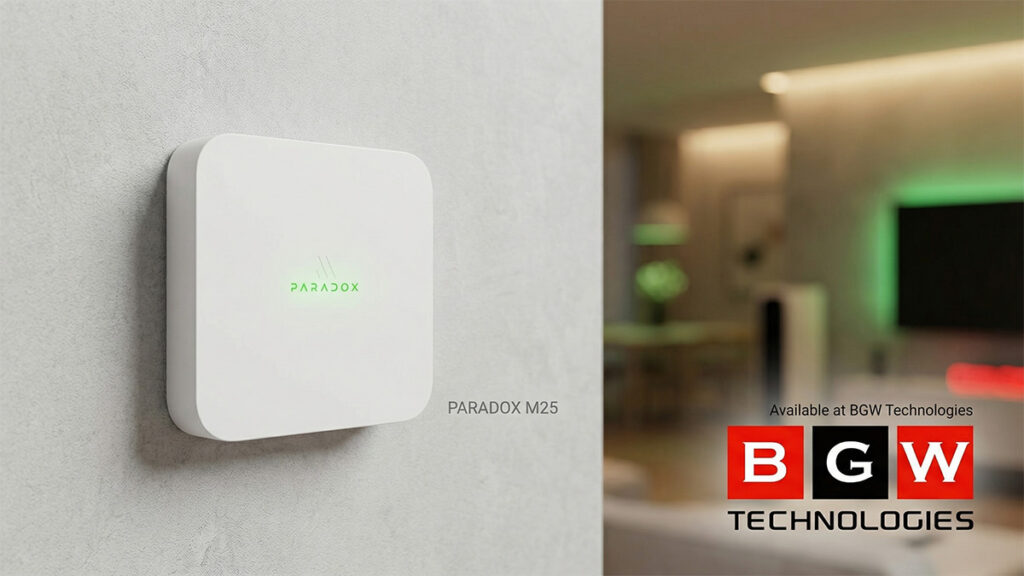
Review Paradox M25 Alarm Panel – Paradox M25 from BGW Technologies is one of a new breed of alarm systems that almost defies categorisation – it’s well on the way to being an integrated security solution right out of the box.
I spent a lot of time stirring words with the M25 – some products are simply easier to write down. In the case of the new Paradox M25 alarm system the challenge is that you’re not writing about a hub or a controller with some sensors. As well as having lateral elements, the M25 is an evolving ecosystem.
There’s a hub, expanders, wireless repeaters, takeover devices, intrusion detection devices (lots), interfaces, fire detection sensors, object movement sensors, flood sensors, automation options and control software, with CCTV and access control functions, modules and software options incoming. It’s not easy to pin the boundaries of a system like this.
I get my M25 demo with Stanley El Komala of BGW Technologies. While I really love alarm and automation solutions of all kinds, El Komala takes this level of engagement to another level. His home alarm system has hundreds of inputs and outputs, and El Komala’s deep knowledge and curiosity not only makes for an interesting conversation it gives serious depth to his observations about the M25 and the alarms market in general.
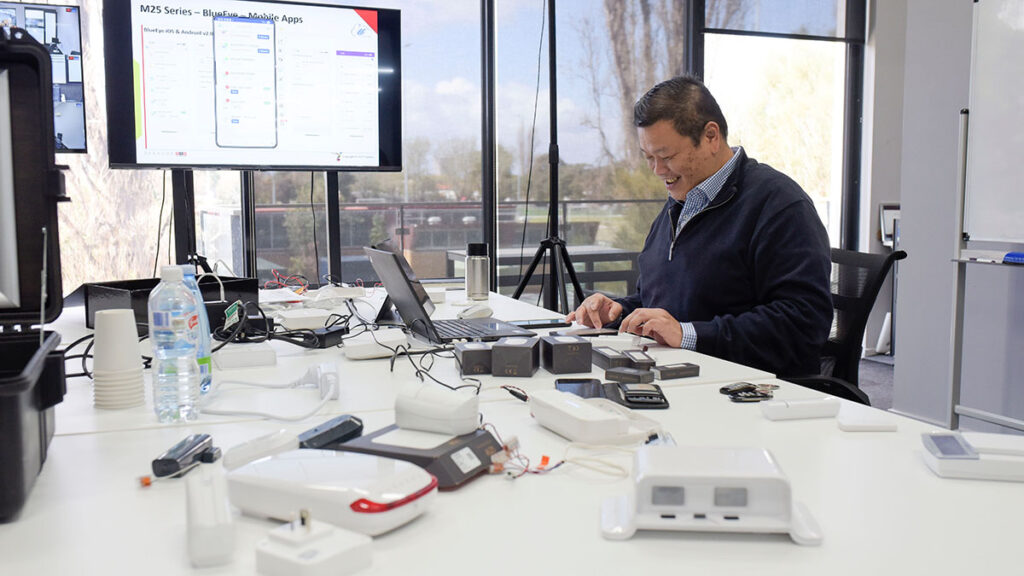
One of the cool things about the M25’s core functionality El Komala points out is that it offers single cable operation (with Wi-Fi backup). The hub is PoE powered directly or via a 15W PoE injector, with Ethernet and Wi-Fi comms paths making for easy install and integration with cloud-based and network-based software.
El Komala says a second version of the panel, which includes Ethernet, Wi-Fi and dual-SIM ports is in stock now. Importantly for installers, there’s no lock-in with this version, so installers can provide their own SIMs.
Reliable external comms is a key element of this system. The unit supports direct-connect reporting architecture, allowing communications independent of cloud pathways, with up to 4 simultaneous supervised connections to IPC10 and VIPC20 IP converters.
The IPC10 is a rack-mounted monitoring station or control room element, providing IP-based alarm transmission and it forms part of the system’s direct-connect reporting architecture. Meanwhile the VIPC20 is virtual software that could be run in a PC/virtual machine environment and offers similar functions to the IPC10. The IPC10 could do 5000 accounts, while the VIPC20 can do 20,000.
Importantly, the IPC10 or VIPC20 enables the panel to communicate with CMS infrastructure over IP without relying on cloud relays, supporting direct panel-to-CMS communication. The module supports supervised communication and can operate as 1 of up to 4 simultaneous IP reporting paths, improving redundancy and transmission reliability.
“Having simultaneous supervised connections to the IPC10 control room receivers means M25 panels maintain a constant online status through direct, supervised communication,” El Komala explains.
“The M25 has 2 paths; one goes to cloud for the BlueEye mobile apps control and allows programming of the M25 panel. Meanwhile, the second path direct from the M25 panel to the CMS for back to base monitoring.
“Depending on the version you choose, a single Cat6-to-RJ45 cable can delivers both PoE and Ethernet, cutting down on cabling and simplifying the setup process.
“And this simplification extends to system security, with operation protected by built-in 2-way authentication, ensuring only the right people have access to system operation layers.”
Neat, too, the hub supports continuous supervision of connected devices and communication paths internally, with event logging and reporting functions built in. For real world security operations this is solid stuff that can be used to provide faster response based on enhanced situational awareness.
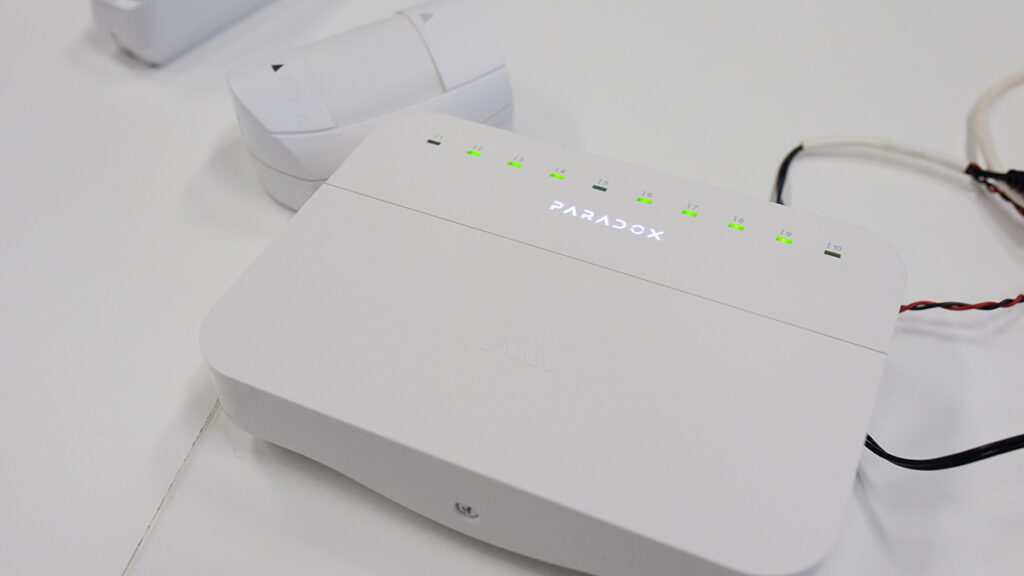
My first impressions of the M25 recently were how small the hub/head unit was – it’s tiny – and weighs just 260g. But as El Komala points out, while the control unit is small, the functionality is not.
“The head unit of this M25 is very compact – probably the smallest I’ve ever seen – but the features list is extensive – it’s far bigger than most applications would require,” El Komala explains.
“Out of the box there are 100 wireless alarm zones standard (with 45 expansion devices), 10 partitions and support for 128 users and 128 remotes. An M25 system scales up to 75 wireless nodes with everything supported by an integrated 5000mAh battery, which gives around 26 hours backup via Ethernet and 24 hours on Wi-Fi or 4G.”
The panel M25 could do up to 100 zones (using the latest software 1.29.012; you can now do up to 200 zones). Of these zones you could do up to 75 wireless nodes (wireless devices; wireless PIR, wireless reed switch, wireless sensors, etc) and 25 zones could be hardwired zone using the ZX10M hardwired to wireless takeover module. Or you could do mix and match – for instance, 50 wireless sensors and 50 hardwired zones.
The M25 also features temperature monitoring with programmable control outputs for commercial applications. Meanwhile, event storage includes approximately 1000 security events and 2000 access events.
El Komala says something that delayed the release of the M25 in Australia was its desirable 918MHz bandwidth. Products using the 918MHz bandwidth deliver excellent range, high security and excellent resistance to interference but it’s a longer process to get compliance for these higher frequencies than for 433MHz.
El Komala point outs that the team invested significant time and resources to tick off all the regulatory and compliance requirements so the entire Paradox M25 product range could be brought into Australia exclusively by BGW Technologies.
According to El Komala, the extra time taken to make the shift to 918MHz was well worth it to get the M25 out of the noisy and crowded 433MHz environment, allowing it to deliver higher security and much longer range – we agree with him.
“With the M25, Paradox has used duplex 2-way wireless communication with Gaussian frequency shift keying (GFSK) modulation and frequency hopping, rather a fixed frequency.
“This means the system operates across a frequency range of approximately 915 to 928 MHz via multiple sub-frequencies and this frequency hopping significantly improves resilience in challenging RF environments, as well as delivering encryption.
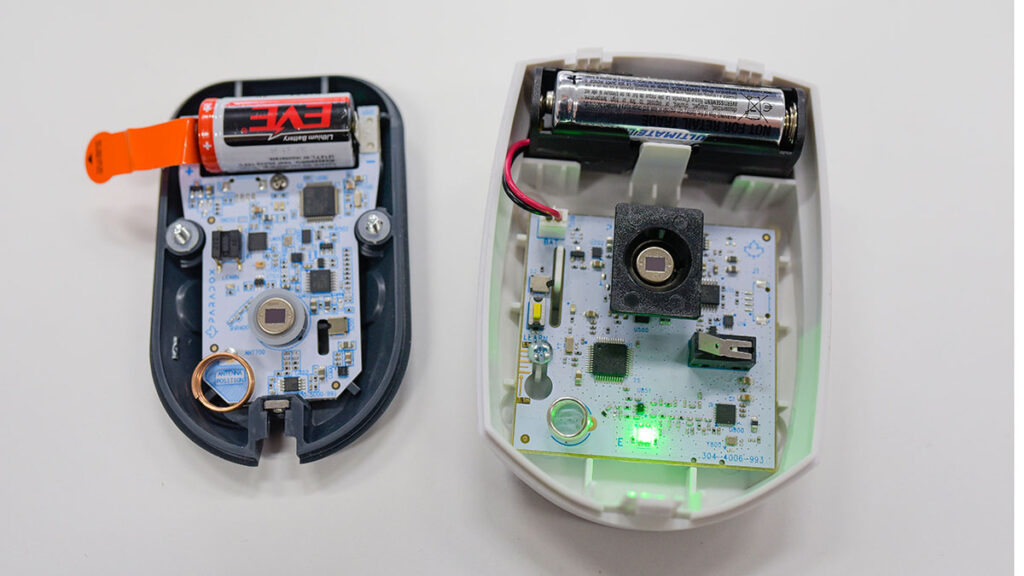
The system’s range is significant.
“RF output is around 22dBm for the panel, while battery-powered devices operate at approximately 14dBm to meet regulatory requirements but even at the lower dBm they offer a range of 2500 metres in open space and line of sight.”
It goes without saying that 2500 metres is good conditions is epic hub-device range for wireless security devices but it’s not the only strength of this compact Paradox powerhouse.
As El Komala points out, Paradox designed the M25 and its ecosystem to make life easy for installers. Device enrolment is auto-learn for wireless and Ethernet devices, and there’s QR code scanning or manual serial number entry for pre-programming.
Auto enrol is of particular interest to SEN’s editor because we found the old coded systems so time consuming and complicated and always needed to call for help. Comparatively, auto-enrol with QR codes is like magic. As we go through our M25 demo, we also go through the process of enrolling devices via the Paradox BlueEye mobile app on El Komala’s phone.
The process is virtually instantaneous, which is great for the time-pressed tech. You hop into the app, enrol a device, scan a QR code, name the device and space, and you have access to sensor settings and functions.
I can’t help observing again the small size of this controller – it’s more a box than a hub. El Komala says this reflects a shift in wider electronics towards IoT hardware.
“With the latest board designs, smaller battery sizes and the use of wireless for system communications, including expanders and repeaters, there’s just no need for a huge control panel in a metal housing with lots of air space for cabling and a big lead acid battery,” he explains.
“New board designs are far more compact, LiFePo batteries are comparatively tiny and with the M25 you have all the capability you need locally with additional functionality overlaid in the app or system management software.”
This system is obviously much more capable that required for a typical residence, isn’t it? I ask.
“Paradox engineers definitely had the SMB market as well as the residential market in mind when they sat down to map this system out,” El Komala says.
“The core functionality is more than enough for a very large home running up to 200 zones with the latest software, as well as automation, but the engineers layered in even more expansion via additional devices, giving more flexibility.”
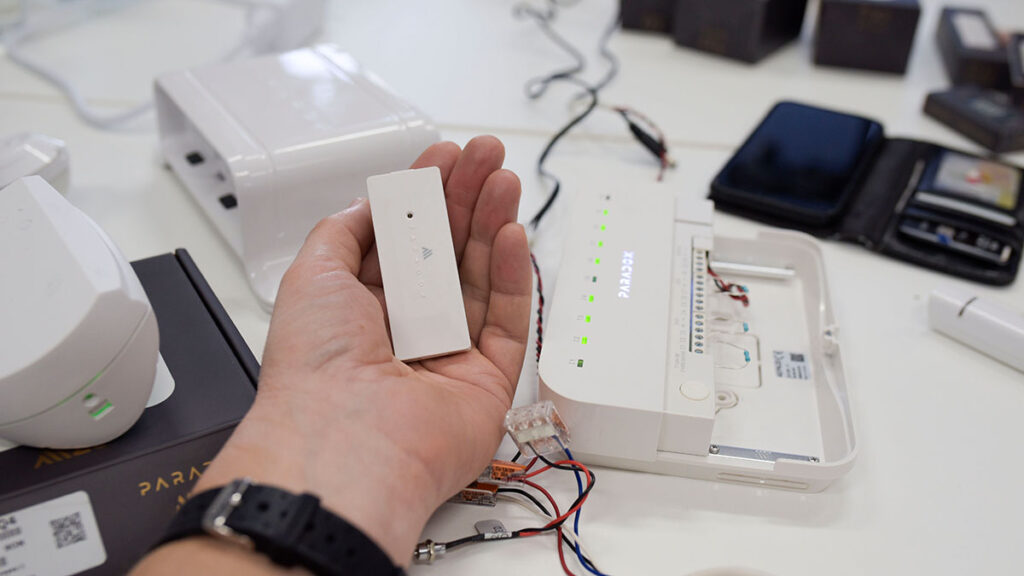
Exploring The Paradox M25 Ecosystem
While it’s easy to get on solid ground with the sensor collection, things are more complex when it comes to Ethernet expanders, wireless repeaters, PGMs, multi-function keypads, and CCTV and access control modules. These components broaden the M25’s possibilities significantly.
The challenge of pinning down the scale of the M25 isn’t because the zone and automation count built into the hub isn’t clear but because so many repeater/expanders can revolve around it, with expansion also built into keypads. How big is the system? That depends.
In terms of geographic expansion, the M25’s RPT5M PoE wireless repeater is designed to extend system range an additional 2500 metres in larger or obstructed installations. It operates in the same 918 MHz bands using GFSK modulation with frequency hopping, maintaining encrypted communication between devices and the hub, just as you’d expect.
Importantly, the repeater supervises connected devices and reports signal integrity back to the panel. This functionality allows techs to monitor marginal links and to expand system coverage without needing to introduce external communications paths.
The PoE RPT5M features a backup 5000mAh battery and it’s compact, too, at around 12.5 x 12.5 x 3.5cm, with a weight of 260g. It supports to 75 devices via up to 4 repeaters. There’s the same auto-enrolment for this device as you use for sensors and same as the hub, you manage expander functionality via the BlueEye app or PC software.
Things get more lateral when you start talking about keypads, one of which integrates a repeater that is also a zone expander.
“Expansion is layered across the M25, and this gives installers a lot of flexibility to grow solutions organically in areas they install certain devices,” El Komala explains.
“For example, there’s a wireless repeater-enabled keypad supporting 32 to 48 additional zones, with future development including a Wi-Fi touchscreen keypad supporting up to 100 zones.”
“A new Wi-Fi Touchscreen Keypad (K70M) is currently not released yet; it’s in Alpha version; but we will show it during SecTech 2026 so keep an eye out for that.”
Main features of the K70M will include security, cameras, automation, internet radio with external speaker output.
Expansion isn’t limited to inputs – outputs are covered, too. Paradox PGMs give the M25 considerable operational flexibility – depending how you are managing rules in software they deliver a lot of automation horsepower.
Each PGM allows the M25 to variously control external devices, including lights, doors and gates, pool pumps, irrigation – whatever you need – via wireless. The PGM’s programmable relay output offers duplex comms, which is great for situational awareness, and for good measure includes a hardwired zone input.
When talking about system expansion we can’t leave out video surveillance – the system supports 16 cameras via BlueEye and El Komala says it may deliver visual verification to the control room.
Adding to this core functionality is an access control module that will support up to 16 doors, as well as handling the integration of up to 16 cameras via the BlueEye app.
Taking expansion a step further, El Komala says there’s also a takeover module designed for existing hardwired systems. This module allows legacy wired devices to be brought into the new platform. Supporting 10 zones, the takeover module includes battery backup and communicates directly back to the M25 panel, making remote management seamless.
There’s also a ZX10 module which provides 10 wired inputs (you can configure 1 as a 24-hour fire alarm zone), operating within the 918 MHz ecosystem. ZX10 is an ecosystem of its own and it’s this varied expandability that makes the M25 flexible and difficult to pin down when it comes to specifications. This system is built to be open – to evolve in real time – in many directions at once.
When it comes to output expansion, the Paradox PGM8M 8-output expander features 8-programmable outputs (24V/1A max switched each output), manual control for each output, a temperature sensor and backup battery options.
Meanwhile, the Paradox ZX10M incorporates a 5000mAh battery, an auxiliary output, a temperature sensor, and a support input with no EOL resistor, a single EOL resistor, or dual EOL resistors. Both these expanders are 12V powered.
Another interesting element of the system when it comes to expansion is the K38M 48-Zone wireless fixed LCD keypad, which can operate using 6 to 14V DC with a tiny consumption of 100 mA. This unit features 48 zones, 2 partitions, a panic button, 4 PGM activation keys, a temperature sensor, night illumination, as well as driving on the same GFSK duplex encrypted and hopping comms path as the rest of the system.
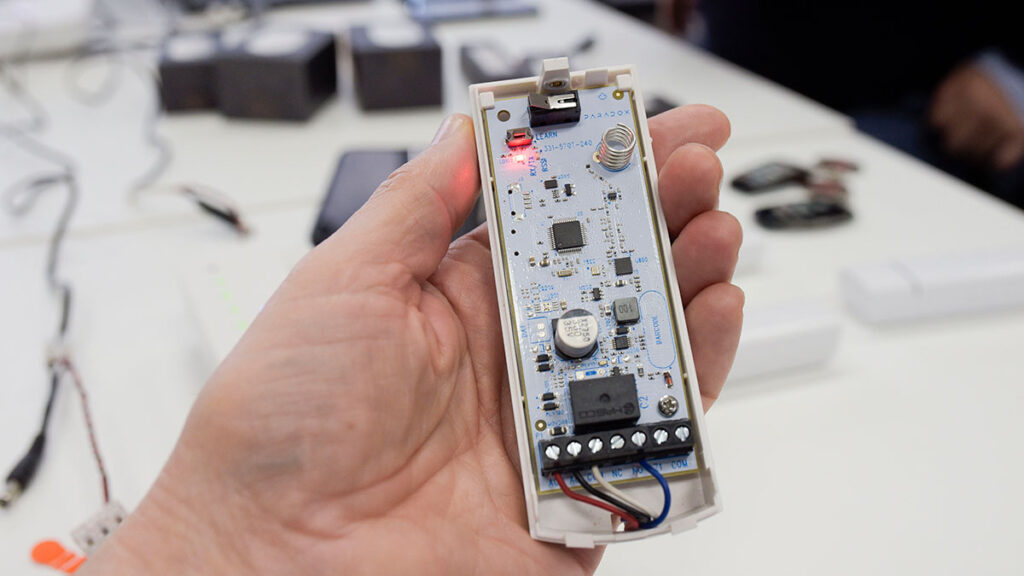
There’s also a 1 output expander, the PGMZ1M, which includes a programmable output relay and 1 zone input, with a maximum switched output of 24V at 1A. It operates on AC/DC 5–16V with a minimum 300mA supply. Features of this unit include a temperature sensor and 12V power, output status indication, tamper status, power supply monitoring, temperature reporting, and TX/RX values. This little expander is compact – unit weight is just 77g. There. Are also ZP2M (2 zones hardwired inputs and 2 PGM output) wireless modules available.
Paradox M25 Detection Devices
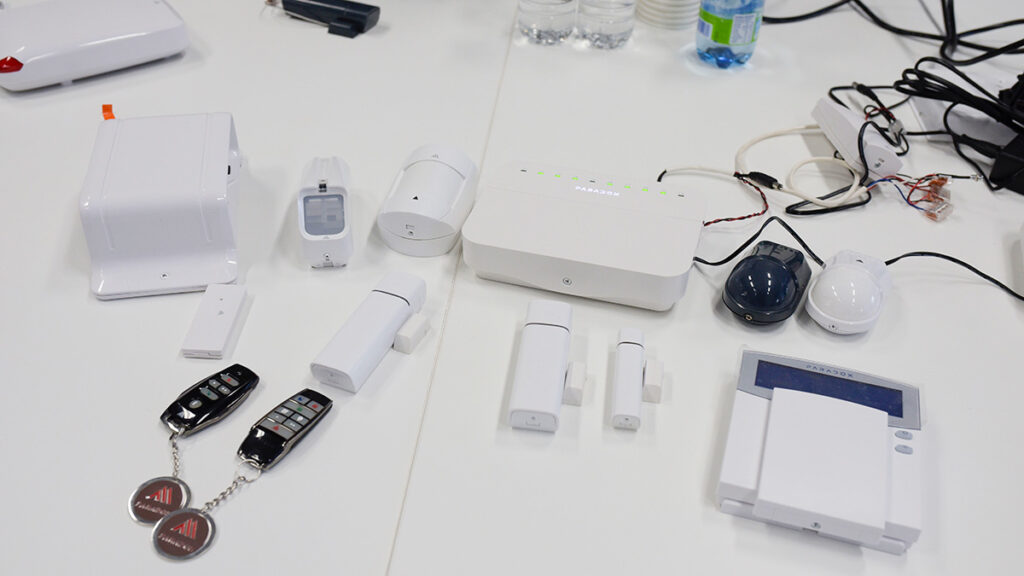
It’s at this point in our demo that I start picking through a groaning table of devices in the BGWT meeting room. I note the high build quality and compact size of the devices. El Komala says device miniaturisation is a continuing trend.
As mentioned, this is an ecosystem, not a hub. There are internal and external sensors, expanders, repeaters, keypads. Plenty of great operational solutions here, I mutter to myself as El Komala auto enrols a siren.
While I’m working out which sensors detect what, El Komala starts pointing out the key devices, explaining that the latest models are more compact than devices of the past, making them more discreet and giving longer battery life.
El Komala starts with door contacts – these include a slim model and a larger version with an additional hardwired input, allowing a second zone, such as a door and frame, or an auxiliary input.
I dig out an interesting looking sensor – it’s the AMD12M – with an integrated accelerometer, and El Komala points out that this unit detects movement across X, Y and Z axes, allowing it to be used on safes, artwork or other assets where tilt or movement indicate tampering.
We look at a dual curtain detector with 12 metre per side detection zones designed to create narrow detection zones making it idea to protect windows or verandahs. DIP switch configuration allows installers to reduce detection distance as required.
There’s a serious spread of sensors for the M25 – we’ll just touch on a few kicking off with the PMD5M, an indoor miniature motion detector, which uses the M25’s GFSK 2-way wireless path with frequency and encryption hopping.
This sensor has a dual rectangular element PIR sensor with 110-degree coverage to 12 metres. The unit includes a super creep down-looking beam, integrated mounting bracket for fast installation, sensitivity level and detection energy control, multiple processing modes, and a temperature sensor. Battery life is 6+ years with normal usage.
Meanwhile, the PMD3M is a compact indoor analogue single-optic wireless PIR motion detector using the same GFSK 2-way comms with frequency and encryption hopping. It features a dual rectangular element, 110-degree coverage to 12m, sensitivity level and detection energy control, a temperature sensor, and 6+ years of battery life with normal usage.
A step up is the PMD75M, a digital dual optic motion detector with advanced real pet immunity up to 40kg. It incorporates 2 dual-opposed infrared sensors. Coverage is 90-degrees out to 11m, with the centre beams extending to 15m. Features include dual-optic PIR sensors, detection energy level control, multiple processing modes, a temperature sensor, and 6+ years of battery life. The unit supports remote programming over the air via BlueEye.
Another capable detection option El Komala shows me is the PMD37M, an indoor and outdoor curtain motion detector with anti-masking capability that’s idea for verandahs or perimeter walls. It includes dual-element, dual element PIR sensing and coverage is 88.5 degrees to 11m, with centre beams out to 15m. Meanwhile, pet immunity mode covers 7.5m by 2m and there’s sensitivity level control, anti-mask sensitivity adjustments, a temperature sensor, and 6+ year battery life.
“Another strong sensor is the PMD85M, an outdoor dual-optic PIR motion detector with advanced pet immunity,” El Komala explains. “It has dual element infrared sensing and 90-degree x 11 metre coverage.”
Other features of the PMD85M include sensitivity level and detection energy control, changeable lenses, an impact-resistant and temperature-resistant casing, a temperature sensor, and 6+ years of battery life. Unit weight is 0.27kg – it’s a bigger sensor than the internal units.
Next comes the PMD780M, an outdoor dual-side view motion detector that incorporates 4 dual low-noise rectangular elements and provides detection from 3m to 12m on each side. Features include dual-side detection, reporting as single or dual units to separate zones, sensitivity level control, multiple processing modes, a temperature sensor, and 6+ years of battery life. Unit weight is 0.45kg.
We’ve mentioned the AMD12M already – an indoor motion sensor that features a 3-axis accelerometer sensor with sensitivity level control and detection based on seconds of constant motion. Battery life is 3+ years with normal usage, and the unit includes a temperature sensor. Dimensions are 30W x 76H x 10D mm and weight is 200g.
The next sensor I pick up is the FD25M – an indoor water detector, which activates a local sound alert as well as reporting water detection events. It has a temperature sensor, and 6+ years of battery life. The FD25M can control a water supply valve, though this is not included.
Handling smoke detection is the SD760M10 is a photoelectric detector with a built-in alarm siren, test fire alarm button, temperature sensor, and 10 years of battery life with normal usage.
There are several external siren options, including the SR230M, which delivers 100dB or more at 1m via a piezo siren and includes an integrated strobe light. Features include lens colour options of red, blue, and amber, weather resistance, a temperature sensor, and 12V power and a unit weight of 0.55kg.
There’s also the SR250M, an outdoor wireless siren with an integrated strobe light, weather-resistant housing, and lens colour options of red, blue, clear, and amber. It includes an external power supply connector, temperature sensor, and requires 12V power.
While we are running through the sensor range – and this is only a portion of the possibilities – El Komala is busy auto enrolling devices to the system via the BlueEye app. It’s as easy as you’d expect it to be. Create the space, scan the code, name the sensor.
Driving The Paradox M25
When it comes to driving the Paradox M25 there are plenty of options, from workstation software to mobile app, keypads, touchscreens, and if you’re a person who appreciates straightforward functions without the need to peel back operational layers on a mobile device, there are keyfobs, too.
We’ve talked about the expanding keypad already but there’s also a handsome 7-inch touchscreen – the K70M – which supports Wi-Fi B/G/N and can handle security, cameras, access, temperature and output control. Again, this device needs a 12V DC supply and there’s a backup battery giving 24-hour support to cover power outs.
Most people drive their alarm systems via apps these days, but we think there is still a place for a single key fob arming device. Fobs are quick, easy and always in your pocket. M25 remote controls include 4-button and 5-button variants, along with the new REM28M, an 8-button remote with a water-resistant, durable design. It provides system status, backlit buttons, and audible indications.
“The system supports up to 128 remote controls, which is plenty for typical residential or SME applications and a single user can be assigned up to 4 remotes as required,” El Komala explains.
System management is handled through Paradox’s application and portal environment. The platform supports authenticated user access, system configuration and remote management.
It allows end users to arm and disarm the system, receive event notifications, and view system status. Meanwhile, installers can configure zones, manage users, update firmware and perform diagnostics remotely. This platform (what’s it called, Stanley) supports secure device identification within the Paradox ecosystem and is structured to manage multiple systems and sites from a single interface.
“Installation companies can also use the Paradox Service Company Portal, a platform that allows installers to manage sites, installer access, and site payments,” El Komala explains.
“It provides a centralised interface for overseeing assigned sites, collaborating with other installers, and handling administrative tasks. Using this portal the authorised service company owner and service company master users can view sites, invite installers, revoke access, grant access to user installers, and perform batch payments.”
Then there’s BlueEye, which is the Paradox mobile app for iOS and Android that provides real-time alarm notifications and remote control of the alarm system. It allows users to arm and disarm systems, manage multi-user access with customised permissions, and configure systems through a user-friendly interface.
This app supports easy setup and is provided with a 1-year free subscription and having watched El Komala undertaking the process of enrolment using it, I can see it’s a highly polished management portal that gives complete control, as well as situational awareness – that’s what you want from a modern alarm-automation-access control-video surveillance system.
Thinking about the M25 after my demo it’s clear that Paradox has engineered a future-facing solution. The system offers excellent connectivity, incorporates cybersecurity, has capable management, features serious expandability of inputs and outputs, has the wide range of device offerings installers need to differentiate solutions in today’s competitive alarms market, and, most importantly, has a roadmap for evolution.
Particularly interesting elements to look out for in apha and beta versions at SecTech 2026 this May include access control and video surveillance, which means the M25 will deliver installers and integrators an alarm and automation solution that can handle the access and CCTV requirements of a significant portion of an installer’s SME customers, as well as supporting the most serious residential applications.
“The new Paradox M25 is designed to grow, evolve, be more secure, to have longer range, to support greater functionality and to make installers’ lives easier by speeding up installations without compromising capability,” El Komala says.
Having sat through a comprehensive demonstration we fully concur with that.
You can learn more about the M25 from the BGW Technologies team here or read more SEN news here.
Paradox M25 Alarm Panel Features
- Built in wireless, Ethernet, Wi Fi and LTE communications
- Support for security, video verification, access control and automation
- PoE powered operation with integrated battery backup
- GFSK wireless on 868 MHz or 914 MHz with encryption hopping
- Direct CMS reporting without cloud dependency
- Auto learn enrolment for wireless and Ethernet devices
- Temperature monitoring with programmable control outputs
- Support for up to 10 partitions, 100 zones and 128 users
- Certified to EN 50131 Grade 2 and related standards (Review Paradox M25 Alarm Panel).
“Review Paradox M25 Alarm Panel Reveals A Profound Security Ecosystem Capable Of Supporting Complex Applications.”
Review Paradox M25 Alarm Panel Review Paradox M25 Alarm Panel Review Paradox M25 Alarm Panel Review Paradox M25 Alarm Panel Review Paradox M25 Alarm Panel Review Paradox M25 Alarm Panel Review Paradox M25 Alarm Panel Review Paradox M25 Alarm Panel Review Paradox M25 Alarm Panel Review Paradox M25 Alarm Panel Review Paradox M25 Alarm Panel Review Paradox M25 Alarm Panel Review Paradox M25 Alarm Panel Review Paradox M25 Alarm Panel Review Paradox M25 Alarm Panel Review Paradox M25 Alarm Panel Review Paradox M25 Alarm Panel Review Paradox M25 Alarm Panel Review Paradox M25 Alarm Panel Review Paradox M25 Alarm Panel Review Paradox M25 Alarm Panel Review Paradox M25 Alarm Panel Review Paradox M25 Alarm Panel