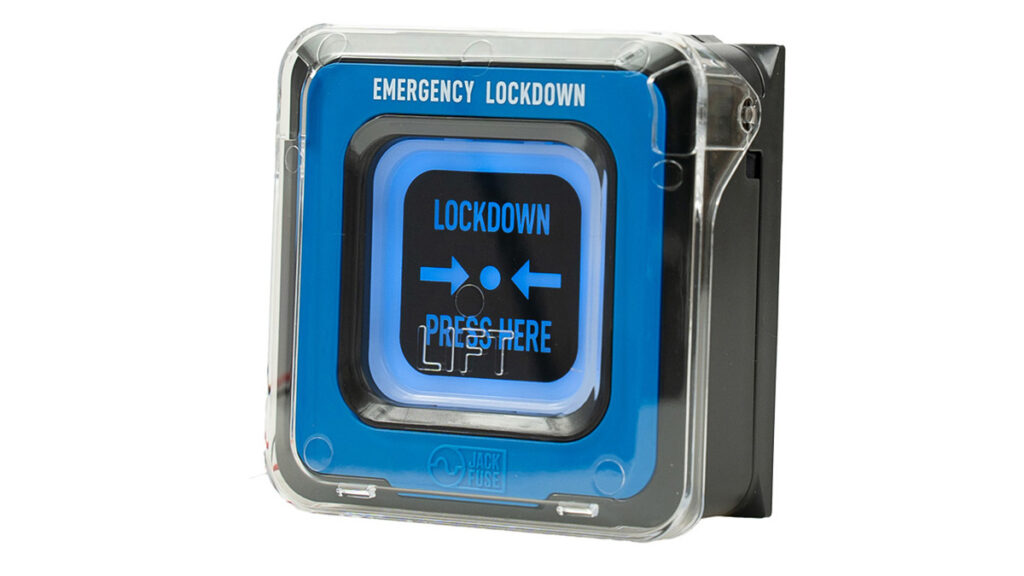




New Jack Fuse SCP V1 Safety Call Point Manual Alarm Activation Device.
New Jack Fuse SCP V1 Safety Call Point – Jack Fuse has released the SCP V1 Safety Call Point, a manual alarm activation device designed for integration with electronic security and access control systems, with a focus on redundancy, monitoring and fail-safe operation.
The SCP V1 is a hardwired call point used for duress, lockdown and assistance applications across environments including interview rooms, reception areas, factories, schools, hospitals and plant rooms. The unit connects to any standard security or access control system input in the same manner as a traditional duress button.
The design is based on the company’s electronic break glass platform, with additional functionality centred on reliability and system visibility. There are 3 variants available including SCP-A assistance (orange), SCP-D duress (yellow) and SCP-L lockdown (blue).
At the hardware level, the unit uses 4 independent activation switches, each rated for 100,000 operations. Any of these switches will trigger an alarm event, meaning all 4 would need to fail to prevent activation. This is combined with dual relay outputs configured to provide redundancy, so that if one relay fails, the second continues to transmit the alarm signal.
The SCP V1 also incorporates active monitoring. The device is continuously supervised by the host system, with power failure or cable disconnection generating an immediate alarm condition. Tamper monitoring is included, with a switch detecting both case opening and removal from the wall.
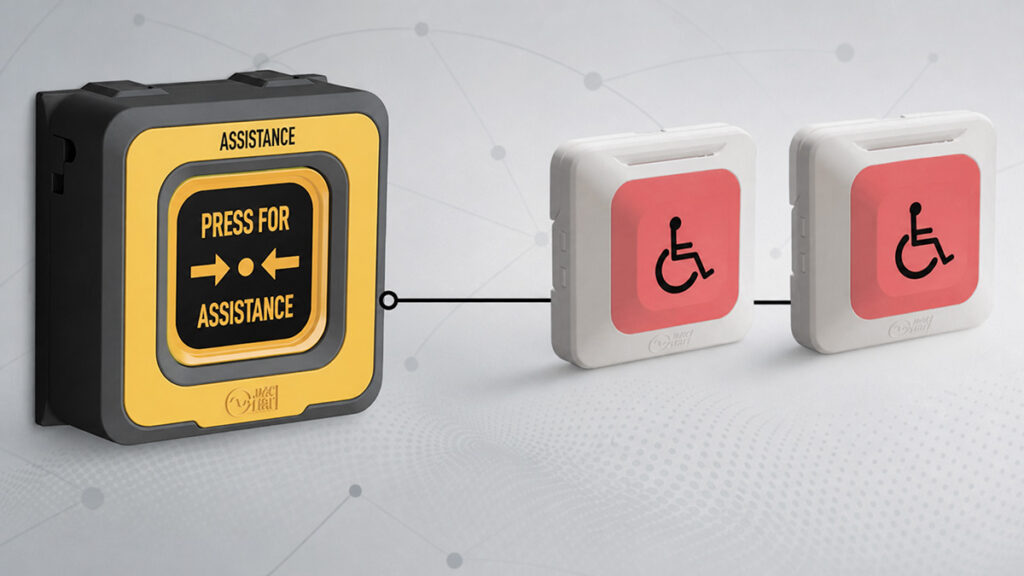
Activation is via a large, backlit tactile actuator designed for visibility and feedback. When pressed, the unit initiates multiple responses simultaneously. The alarm output changes state and signals the host system, the actuator illumination changes to red, and an onboard sounder is activated. An auxiliary output can trigger external alarm indicators.
The device provides both visual and audible feedback to confirm activation, with adjustable LED brightness and sounder volume configurable via onboard settings.
A key integration feature is a direct output for external indicators, including Jack Fuse Lodestar alarm status units. The onboard output can drive up to 2 indicators directly, reducing cabling requirements and the need for additional system programming or hardware.
The system supports both remote and local reset. Remote reset is achieved via power cycling, which can be initiated through a switch, system output or software-controlled event. This allows alarms to be cleared without physical attendance, particularly in remote or monitored environments. Local reset is available via an onboard button and can be disabled if required.
An activation guard is supplied as standard, using a lift-up cover to reduce accidental operation.

From an operational perspective, the SCP V1 is designed to operate within standard alarm monitoring frameworks. Activation, tamper, power loss, reset and cable faults all generate alarm conditions within the host system. Where 4-state monitoring is used, both short circuit and open circuit conditions are detected.
Power requirements are 12–14VDC at 70mA nominal, with relay contacts rated to 1A. The unit supports standard security cabling, with four-core or six-core configurations depending on whether tamper monitoring is shared or separate.
Physically, the unit measures 86 x 86 x 40mm with cover, and is constructed from polycarbonate and reinforced materials, with compliance to RoHS and relevant EMC standards.
Accessories include surface mounting blocks, Lodestar alarm indicators, and SCAR-C dress plates designed to retrofit the SCP into existing single gang mounting positions, covering legacy fixings and surface marks during upgrades.
The SCP V1 is available now through security distribution channels, with demonstration units installed in Wesco Anixter branches. You can learn more from Jack Fuse here or read more SEN news here.
“New Jack Fuse SCP V1 Safety Call Point Manual Alarm Activation Device.”