


Wire Size Considerations In Large Security Applications Must Take Into Account Cable Run Distance, Minimum Device Voltage, Amplification And More.
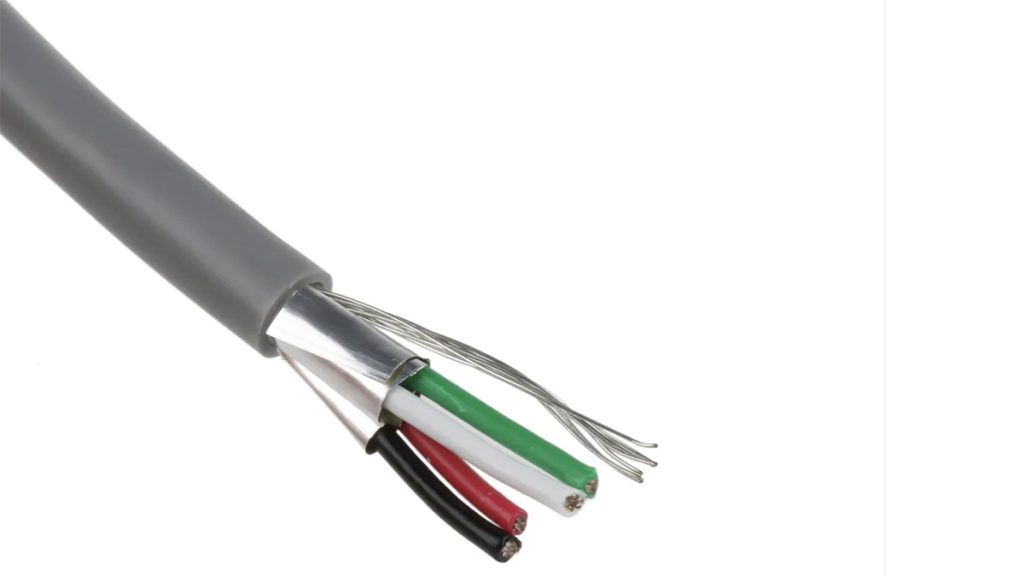
Wire Size Considerations In Large Security Applications – When working on larger installations remember that wire size is rated using the American Wire Gage (AWG) system and it’s all to do with diameter.
The diameter of the wire is important because if the wire’s too small you’ll get power loss caused by resistance and that’s going to mess up your performance. Quite simply, the larger the diameter of the wire, the greater will be its capacity to carry a given current, further and with less loss.
It’s best practice to use a wire with a larger diameter than you need – that’s much better than having one that’s too small, though there are cost issues.
In terms of their ability to carry power, 18 AWG will give adequate performance at up to 200m, 16 AWG will give adequate performance to just under 300m and 14 AWG will handle just under 350m.
You should consider the recommended AWG – it’s going to be 22 for sensors and 18 for high power devices. But these recommendations don’t mean you’re stuck using a set AWG when you’re looking to minimise resistance.
It’s worth noting that there’s no universal distance for a particular AWG. Supply voltage, current consumption, conductor material, connection resistance and the minimum voltage required by the field device are all factors that need consideration.
Peak current is important, too. A device that appears comfortable on a long cable run during normal operation may suffer excessive voltage drop when a lock operates, an illuminator switches on, a siren activates, etc.
Unsurprisingly, larger copper conductors cost more, are heavier and occupy more conduit and termination space. They can also be less convenient to tuck cleanly into small field devices and terminal blocks. Across a monster installation the additional copper cost can be substantial. That said, with a security and life safety solution sometimes the low-cost option is to suck up the more expensive cable cost and install the larger AWG. The additional cable cost will be insignificant compared with troubleshooting intermittent field problems, installing additional power supplies later or replacing undersized cabling later.
Wire Size Considerations In Large Security Applications
There are alternatives. Local power supplies can dramatically shorten high-current cable runs, while fibre can carry communications over long distances with electrical isolation and immunity to electromagnetic interference. Depending on system architecture, installing quality larger multicore or composite cables may be better than pushing smaller conductors to their limits.
Low-cost copper-clad aluminium and aluminium conductors will be tempting but they come with issues of their own. Aluminium has higher resistivity than copper, so a larger conductor is required to achieve equivalent electrical performance. Termination compatibility and applicable standards also need to be considered.
Obviously, wireless can remove much of the cable-distance problem and is capable in security applications, particularly where cabling is difficult or expensive. But RF is not always ideal. Reinforced concrete, metal structures, plant and electrical interference, changing building layouts and more can compromise performance, while wireless devices still require power, whether locally supplied or from batteries – the latter of which are great until they run out and require a site visit.
There’s also an important distinction between power and signalling. Increasing conductor diameter directly reduces resistance and voltage drop, but it doesn’t mean every communications protocol will operate over a proportionately greater distance. Data performance may be constrained by capacitance, impedance, cable construction, interference, topology and the electrical specification of the communications interface.
For cautious techs, the practical approach is to calculate the worst-case load and voltage drop rather than relying solely on a nominal cable distance. On a long run, moving up a conductor size may seem expensive but it can be considerably cheaper than discovering the copper in 250 metres of cable trays and pits needs upgrading.
You can find quality security cable here or read more SEN news here.
Key Considerations Of Cable Size
- Lower AWG number means larger conductor diameter
- Larger conductors reduce resistance and voltage drop
- Calculate cable runs against maximum device current, not only standby load
- Communications distance also depends on protocol and cable characteristics
- Larger copper cable costs more and requires more installation space
- Local power and fibre can be useful alternatives on long runs
- Aluminium requires greater conductor area than copper for equivalent resistance
- Wireless avoids signal cabling but RF conditions and device power remain considerations
- Allowing conductor capacity in reserve can improve long-term system reliability.
“Wire Size Considerations In Large Security Applications Must Take Into Account Cable Run Distance, Minimum Device Voltage, Amplification And More.”