


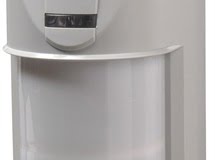


External Alarm Sensors – We’ve talked about the importance of building domestic and small commercial alarm systems with usable perimeter zones before. It’s something that’s not only vital with home security systems intended to protect occupants when they’re at home, asleep and vulnerable. Many alarm systems installed are only useable half the time – that’s the time no one is home.
In fairness, a significant reason for this is that until recently the technology wasn’t available to offer affordable perimeter security for homeowners. The rich could install PE beams but they’re a singular fix and not easily teamed up with choppy domestic architecture.
Now a new generation of high performance alarm sensors changes things completely. These passive infrared and dual
technology alarm sensors offer IP65, IP66 and IP67 ratings – these ratings
really define the ability to muscle up in external applications. While some
sensors are best off installed under rooflines, others can handle full external
installation and will shrug off rain, sunlight and inanimate moving objects in
their scenes without a care in the world.
Before we move further into the story –
consider that the IP ratings work like this. The first digit ‘6’ means the
units are completely protected from dust – all the units we talk about here are
rated against dust. The second digit relates to water. If the number is 4 the
unit is splash proof. You can hose a number 5 unit, hose it hard if it’s number
6 or dunk the sensor under a metre of water if it’s 7. That means IP65 needs to
stay under the eaves, while IP66 rated units can be installed pretty much where
you like. IP67 is tougher still.
You wouldn’t want to rely just on dust
and waterproofing to guide your steps. Another important standard to consider
is EN500131 (sub sections 1 to 6) for electronic security devices. The
guidelines – the only ones of their kind in the world – document the standards
devices must meet in order to achieve security ratings from low (Grade 1)
through to high (Grade 4). The stipulation is that the claims of manufacturers
must be verified by independent test labs.
While this latest push into powerful external
sensors was probably kicked off by Rokonet’s excellent WatchOUT sensor a couple
of years ago, the player in the external sensor market with the greatest
experience is Crow. Back when most PIRs were single pyro and DSP was virtually unknown,
the Crow Double and Dual set the benchmark with its RISC processing and
excellent build quality.
According to Crow Australia’s Mark
Edwards, Crow has been manufacturing high end sensor solutions for the Israeli
Military for over 25 years, and has sensors SCEC endorsed in Australia.
“The D&D was an amazing detector
when it was released in the early 90’s,” Edwards says. “I’ll never forget Crow
installing the D&D under a waterfall at a security show to demonstrate that
it would not false alarm under extreme conditions.
“Thousands of D&D sensors have been
installed in Australia with a surprisingly low failure rate and even now some
installation companies will not use any other product.”
Following the D&D, the next
generation of Crow Outdoor detectors was the MRX range incorporating the MRX220
and the MRX300. Edwards says Crow had good success in Australia with
the MRX300 as this unit had microwave detection and 2 quad pyro sensors in an
IP65 rated housing complete with rain hood.
“The MRX300 has been specified and used
by many of Australia’s top end security integrators,” Edwards says. “The best
endorsement for this product came when it was selected to be used as the
external detector to protect the SydneyHarbourBridge
against terrorism after the terrible events of 9/11.”
Edwards says that drawing on 25 years
experience in designing high quality external sensing devices including
microwave barriers, dual technology and triple technology sensors, has lead to
the recent release of the EDS range of sensors.
“I’ll never forget Crow installing the
D&D under a waterfall at a security show to demonstrate that it would not
false alarm under extreme conditions”
“The EDS series has been one of our most
successful launches of a new sensor and there have been virtually no returns
and reported false alarm immunity has been exceptional,” Edwards explains.
“The EDS2000 DUO incorporates a Quad
Element Pyro Sensor with a X-Band 10.687GHz Microwave movement detector
designed as an eventual replacement for the legendary D&D,” he says.
“The EDS3000 TRIO incorporates dual (2x)
quad element pyro sensors with a K-Band 24.125GHz Microwave movement detector.
This unit has been designed as a replacement for the MRX300.”
Edwards says which of the 2 Crow sensors
installers should use for a given external installation comes down to the
application.
“If PET Immunity is required, the
EDS3000 is the right detector to choose. For accurate PET immunity, the sensor
must be flat mounted or corner mounted in order to eliminate the possibility of
the detector being tilted,” he explains.
“Tilting the detector adjusts the field
of view and puts out the PET immunity calibration. The EDS2000 is ideal for
situations where PET immunity is not the main concern. While the EDS2000 has
PET immunity it is suitable for small animals. And the unit has an optional
bracket which allows it to be swivelled or tilted to capture the desired field
of view making it suitable for even the smallest of back yards.”
Edwards is circumspect when it comes to
what drives installation of high performance alarm sensors.
“Better sensors have always been
available in the Australian market place – it’s just a matter of installation
companies being able to sell systems on features not only price,” he says.
“Consider that Crow has a dual quad
element PIR with two lenses mounted vertically one above the other that
incorporates anti-masking, we also have a quad element pet immune combined
microwave sensor with anti-masking, both of which are under $100 and all our
sensors have a 5-year warranty. So quality sensors exist, it is a matter of
them being sold.”
There’s no question high performance
external sensors have a tough job to do and it’s not every sensor that can
handle the workload. For Andrews, the obvious challenge is the fact the
environment is forever changing.
“The environment is forever changing
with the weather, so the software in the microprocessor of an external alarm
sensor is constantly updating the three dimensional image (of the baseline
environment) in its memory in order to try to avoid false activations,” Edwards
says.
“The other challenge is – how do we know
if the alarm activation was a false alarm? Unless we have cameras in the area,
how can we tell if the external sensor alarm activation was a false alarm or a
real alarm and that the intruder decided not to hang around – that’s a major
challenge.”
Another maker of premium alarm sensors
is Bosch Security and Bosch’s Adam Harris says that installing quality alarm
sensors makes excellent sense.
“There are a number of benefits to
installing a quality detector,” says Harris. “An intrusion control panel relies
on input from the detector so if the quality of the detector is compromised
then essentially the total installation is compromised.
“Total cost of ownership is another
important factor. If detectors false alarm this costs the integrator/monitoring
provider. One false alarm will negate the total saving made on a cheaper
detector,” he says.
“Bosch detectors incorporate many additional
features to improve installation times, make quality installations easier to
achieve and of course improve false alarm immunity and catch performance.”
Harris says Bosch’s stand out performer
when it comes to detectors is the company’s Professional Series range.
“The TriTech anti-mask Professional
Series detector is the only detector world wide to be independently tested to
meet the strict EN grade 3 standards,” Harris explains.
“All Professional Series detectors
feature Bosch Sensor Data Fusion technology. The anti-mask versions
additionally feature Bosch MANTIS (Multi-pointAnti mask with Integrated
Spray Detection) anti mask technologies. Professional series detectors have
been the recipient of many notable international awards.”
When it comes to external work, Bosch’s OD850
TriTech Outdoor detector offers an IP54-rating and a 15m range. The OD850 is a
PIR/microwave intrusion detector that built for use outdoors and in harsh
environments. By using Motion Analyzer II PIR signal processing and linear
travel distance (LTD) microwave processing, the detector can measure the linear
travel distance of a target to provide catch performance of people while
ignoring stationary objects with slight movement such as tree limbs and hanging
signs.
Motion Analyzer II PIR signal processing
uses multiple thresholds and timing windows to analyse timing, amplitude,
duration, and polarity of signals to make an alarm decision. It will not alarm
on extreme levels of thermal and illumination disturbances caused by hot and
cold draughts, sunlight, or lightning.
The combination of advanced processing
techniques and mechanical design combine to provide a detector that offers
superior performance in a wide range of weather conditions. The detector
features two user-selectable PIR sensitivity settings for extreme conditions
that allow further reduction of false alarms.
In addition to an alarm relay, there is
a Form ‘C’ unsupervised, timed relay contact that transfers one second after an
alarm and follows a user-selectable timer. A DIP switch allows the user to
specify whether or not the unit will alarm only during the night. Setting the
switch to ON suppresses the alarm and timed relays during daylight. If the LEDs
are enabled, then LED indications will still continue.
Importantly, Harris says installing
quality alarm sensors like the Bosch OD850 may cost slightly more but the cost
is offset by superior performance and a reduction in false alarms and other
problems.
“Even if the installer only had to
return to an installation once, if this return trip is avoided through the use
of quality products then they have paid for themselves.”
“Total cost of ownership is another
important factor. If detectors false alarm this costs the integrator/monitoring
provider. One false alarm will negate the total saving made on a cheaper
detector”
Something Harris doesn’t mention is that
Bosch is working closely on compliance with those EN sensor security grades
mentioned earlier. These independent standards are a sign of growing maturity
in the market and they allow end users and installers to buy quality solutions
without the froth and bubble of an unsubstantiated sales pitch.
The OD850 is a 15 m by 15 m
PIR/microwave intrusion detector that is intended for use outdoors and in other
harsh environments. By using Motion Analyzer II PIR signal processing and
linear travel distance (LTD) microwave processing, the detector can measure the
linear travel distance of a target to provide excellent catch performance of
people while ignoring stationary objects with slight movement such as tree
limbs and hanging signs. The combination of advanced processing techniques and
mechanical design combine to provide a detector that offers superior
performance in a wide range of weather conditions.
The wall mount outdoor OD850 TriTech
PIR/microwave detector is a detector intended for use outdoors and in other
harsh environments. It uses Motion Analyzer II PIR signal processing and linear
travel distance (LTD) microwave processing to provide excellent catch
performance of people while ignoring slightly moving objects such as tree
limbs. Advanced processing techniques and mechanical design combine to provide
a detector that offers superior performance in a wide range of weather
conditions.
Motion Analyzer II PIR signal processing
uses multiple thresholds and timing windows to analyse timing, amplitude,
duration, and polarity of signals to make an alarm decision. It will not alarm
on extreme levels of thermal and illumination disturbances caused by hot and
cold draughts, sunlight, or lightning.
Linear travel distance microwave signal
processing measures the linear travel distance of a target to make an alarm
decision. It eliminates alarms for objects that move but do not travel, such as
tree limbs and hanging signs.
The detector features two
user-selectable PIR sensitivity settings – standard sensitivity: recommended
setting for maximum false alarm immunity. Tolerates environment extremes on
this setting; and intermediate sensitivity: recommended setting for any
location where an intruder is expected to cover only a small portion of the
protected area. The sensor tolerates normal environments on this setting and will
improve your intruder catch performance.
In addition to an alarm relay, there is
a Form ‘C’ unsupervised, timed relay contact that transfers one second after an
alarm and follows a user-selectable timer. A DIP switch allows the user to
specify whether or not the unit will alarm only during the night. Setting the
switch to ON suppresses the alarm and timed relays during daylight. If the LEDs
are enabled, then LED indications will still continue.
The high-efficiency LED indicators (one
red and one green) use the same technology as traffic lights to make them
visible in sunlight. A DIP switch setting allows the user to disable these LEDs
during normal operation to save power.
Meanwhile over at CSD, product manager
Scott Hamilton says the company’s most capable external intrusion sensor is the
IP-66 rated Paradox DG85.
“It comes with the selectable option of
either “BUS” (Connecting directly onto the EVO panels bus) or
standard Alarm relay,” says Hamilton. “It is also available in Magellan
(Wireless) PMD85. The detector has an option of a curtain lenses which can used
where area width is an issue and length is critical.”
Hamilton says a key element of the DG85
is the fact the sensor is 100 per cent digital.
“Paradox is the only brand of sensor
that’s 100 per cent – there’s no analog processing and that gives you better
protection against false alarms,” he explains.
“Other powerful features include a Dual
Optical Filtering System, multi-level sensitivity adjustment and 2 operational
modes that are addressable for the Digiplex series or conventional relay
operation.”
When it comes to talk about false
alarms, Hamilton baulks.
“False alarms is a term I’m not a fan
of, simply because there is always a reason for an alarm,” says Hamilton.
“Whether it be an environmental reason or a fault.
“The environment is a huge factor and every
environment is different, so this means every set up should be adjusted for,
that’s where a good external sensor needs to have not only the digital
processing power but the ability for physical adjustments such as sensitivity,”
he explains.
“Early detection is the key – this
reduces response time and becomes a huge discouragement for intruders as they
have been detected before the actual penetration of the physical premises
occurs”
“A good sensor will have limited if any
false alarms and provide reassurance that all instances of intrusion are
detected. This is not always the case when providing the customer with lower
quality sensors that cause endless issues that damage the experience of external
protection,” he says. “The Paradox outdoor sensor comes with a bracket for easy
mounting and positioning, which is crucial to outdoor sensors.”
According to Hamilton, the great
strength of outdoor sensors is their ability to extend perimeter security into
the commercial and residential markets.
“Early detection is the key,” he
explains. “This reduces response time and becomes a huge discouragement for
intruders as they have been detected before the actual penetration of the
physical premises occurs.
“We are proud to be able to offer
customers the protection they need and deserve. StayD working in conjunction
with accurate external detection device/s is a work of art, it truly is an awesome
solution for residential and small business,” he says.
Hamilton agrees that as a supplier of
high quality alarm solutions he sees it as important that end users insist on
supporting those powerful alarm systems with quality sensors rather than
scrimping on single or twin pyro clones.
“How much value do you put on protecting
your family and belongings? The whole idea of external detection devices and
StayD as a concept is early warning protection from intruders so you and your
family can react and be safe.
“End users need to start demanding
features other than the traditional ON/OFF alarms to get the full benefits of
what they are paying for,” Hamilton insists.
“It is really important for the end user
to support powerful alarm systems with high performance sensors – it sounds
dramatic but these devices are at the cutting edge of research and development into
the safety of life.”