



Active Infrared Beams In Perimeter Security – Strengths, Weaknesses And Features You Want.
Active Infrared Beams In Perimeter Security – Active infrared beams remain one of the most widely deployed perimeter intrusion detection technologies in electronic security applications. They are simple in concept, relatively inexpensive, and easy to integrate, but performance in tough external environments depends on device design, thoughtful installation, and recalibration as part of maintenance programs.
AIRs beams deliver line-of-sight detection – a transmitter sends modulated infrared energy to a receiver. If the beam is interrupted for a defined period, an alarm is generated. The simplicity of this detection method is a strength and a weakness of the technology – the best AIRs detection solutions are designed to handle typical environmental distractions without registering alarm events.
From an operational perspective, IR beams are highly effective when you can control the environment. Straight fence lines, controlled access points, internal perimeters and defined corridors are all ideal applications for AIRs. In these environments, AIRs beams provide clean, deterministic detection with very low nuisance alarm rates when properly configured.
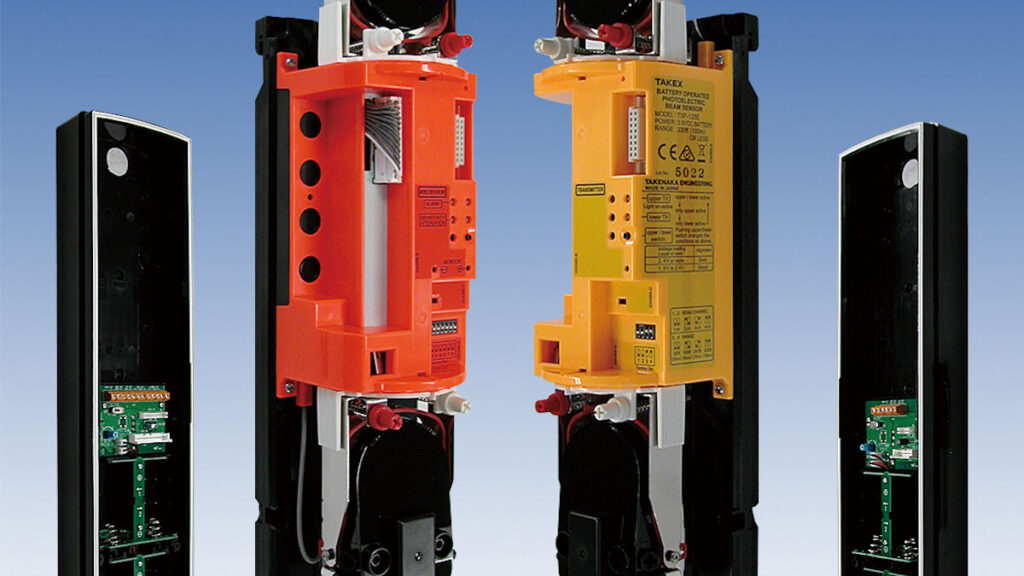
AIRs beams are also super easy to integrate. Most beam sets provide a simple relay output, making them compatible with alarm panels, access control systems and, increasingly, directly with IP-based I/O modules feeding VMS or PSIM platforms. AIRs can be deployed quickly, configured to inputs, and then brought into a broader security management environment with little complexity.
Challenges for AIRs are uncontrolled external environments – these challenges apply to all external sensors, mind you – but installers need to bear the nature of AIRs technology in mind during application. The first issue is attenuation. Over longer distances, the IR signal is impacted by fog, heavy rain, dust and airborne particles. Even with high-power beam sets, environmental load reduces signal strength at the receiver.
Signal margin infographic showing how environmental conditions reduce IR beam detection headroom
Signal margin — how environment erodes detection headroom
~22% headroom above alarm threshold
~8% headroom — quality beam sets compensate with auto gain control
Only 2% above threshold — nuisance alarms likely without AGC
Below threshold — false alarms or missed detections; shorten working distance
Better quality units compensate for this with higher transmission power and gain control and on demanding sites you should use higher quality devices. Consider that modern beam sets can deliver significantly higher beam power than the minimum required and use automatic gain functions to maintain detection margins in poor weather.
Obviously, there are limits. Long-range beams installed at maximum distance are more vulnerable to environmental effects. In practice, experienced installers should shorten the working distance below the maximum spec to build in tolerance and the working distance for a site should not be considered locked in until local performance data reveals pain points over time.
Something else that is key with AIRs is alignment. AIR beams are unforgiving of misalignment. Over distance – and the longer the distance the greater the need for care – even slight misalignment during installation, or movement of the mounting points after installation, results in the beam arriving off-axis at the receiver. This reduces signal margin and increases false alarms or missed detections and techs need to bear in mind that if the optical axis is not aligned correctly, the system becomes more susceptible to environmental effects and false alarms or trouble events.
Four common AIR beam failure modes and their remedies: misalignment, attenuation, environmental noise, and ground movement
Common failure modes & remedies
Misalignment
Optical axis off-centre at receiver; worsens over distance. Reduces signal margin and lifts false alarm rate.
Attenuation
Fog, rain, dust and airborne particles absorb and scatter the IR signal, eating into detection margin.
Environmental noise
Birds, insects, leaves, debris and wind gusts cause transient beam breaks — nuisance alarms on basic units.
Ground movement
Thermal expansion, vehicle strikes, wind load and soil shift move mounting posts — degrades alignment over time.
This need for exacting alignment has practical implications in the field. Ground movement, thermal expansion, vehicle strikes on posts, even fence movement under wind load can degrade alignment over time. This means commissioning and re-commissioning are critical. AIRs beams are not a set and forget technology in external applications – integrators need to factor recommissioning into maintenance schedules.
Another factor that needs consideration is environmental noise. External sites are full of moving objects that are not intruders. Vegetation, birds, insects, debris and even strong wind gusts will interact with the beam path. Lower quality systems will generate nuisance alarms in these conditions while high quality units will take them in their stride by virtue of design.
Shop quality AIR beams


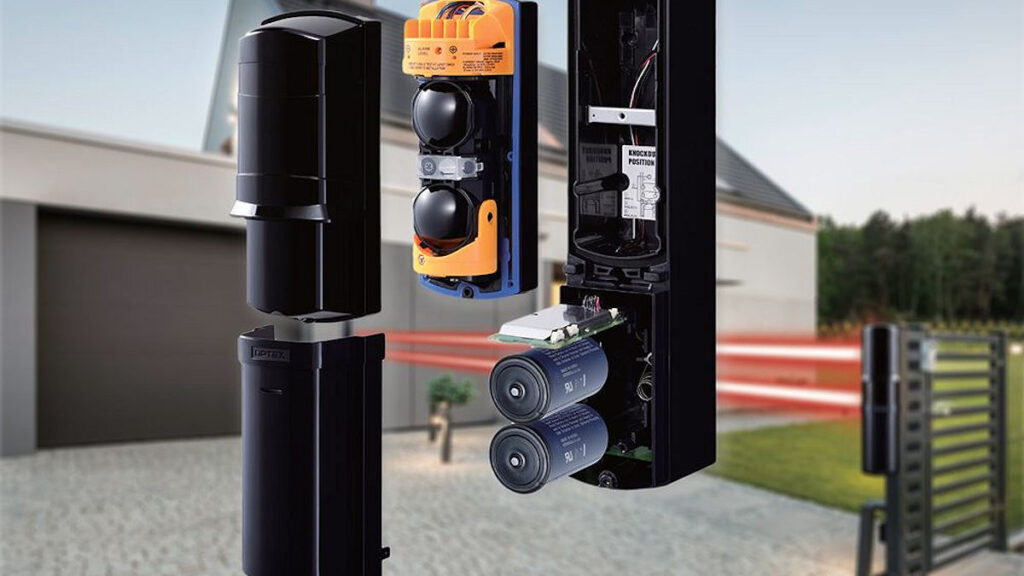
Better beam sets handle environmental noise with multiple beams and signal processing. Quad beam configurations, wider beam spacing and programmable interruption times allow the AIRs sensor to distinguish between small transient objects and genuine intrusion events. Wider spacing between upper and lower beams, for example, reduces false alarms from birds and falling leaves.
Response time adjustment is also critical. If a beam breaks for a few milliseconds, that’s likely a bird. If it breaks for longer, that’s more likely a person. Good systems allow installers to tune this behaviour to suit a particular site.
Another operational consideration is mounting height and geometry. AIRs beams are typically installed around 0.8m high for single lines, or stacked vertically to create a detection plane from near ground level to several metres high. If beams are mounted too high or too low, detection reliability drops significantly. The detection line needs to intersect the human body in a predictable way.
Stacked beams improve detection probability and resistance to crawl-through or step-over attempts, but they also increase complexity. You need to manage cross-talk, ensure matched modulation frequencies and maintain alignment across multiple axes. The process is not challenging for a capable tech but it requires adherence to manufacturer procedure.
From a security perspective, IR beams are strong at detecting intent – a person has to physically cross the beam path to generate an alarm. That makes them less prone to the interpretation issues seen with video analytics. Conversely, AIRs beams provide no classification – they don’t tell you who or what caused the alarm, only that the beam was broken.
That’s where integration becomes important. In modern systems, IR beams are rarely deployed in isolation. They are typically integrated with CCTV, triggering cameras to record or move to presets, and feeding alarms into VMS for operator verification. This hybrid approach combines the deterministic detection of beams with the situational awareness of video.
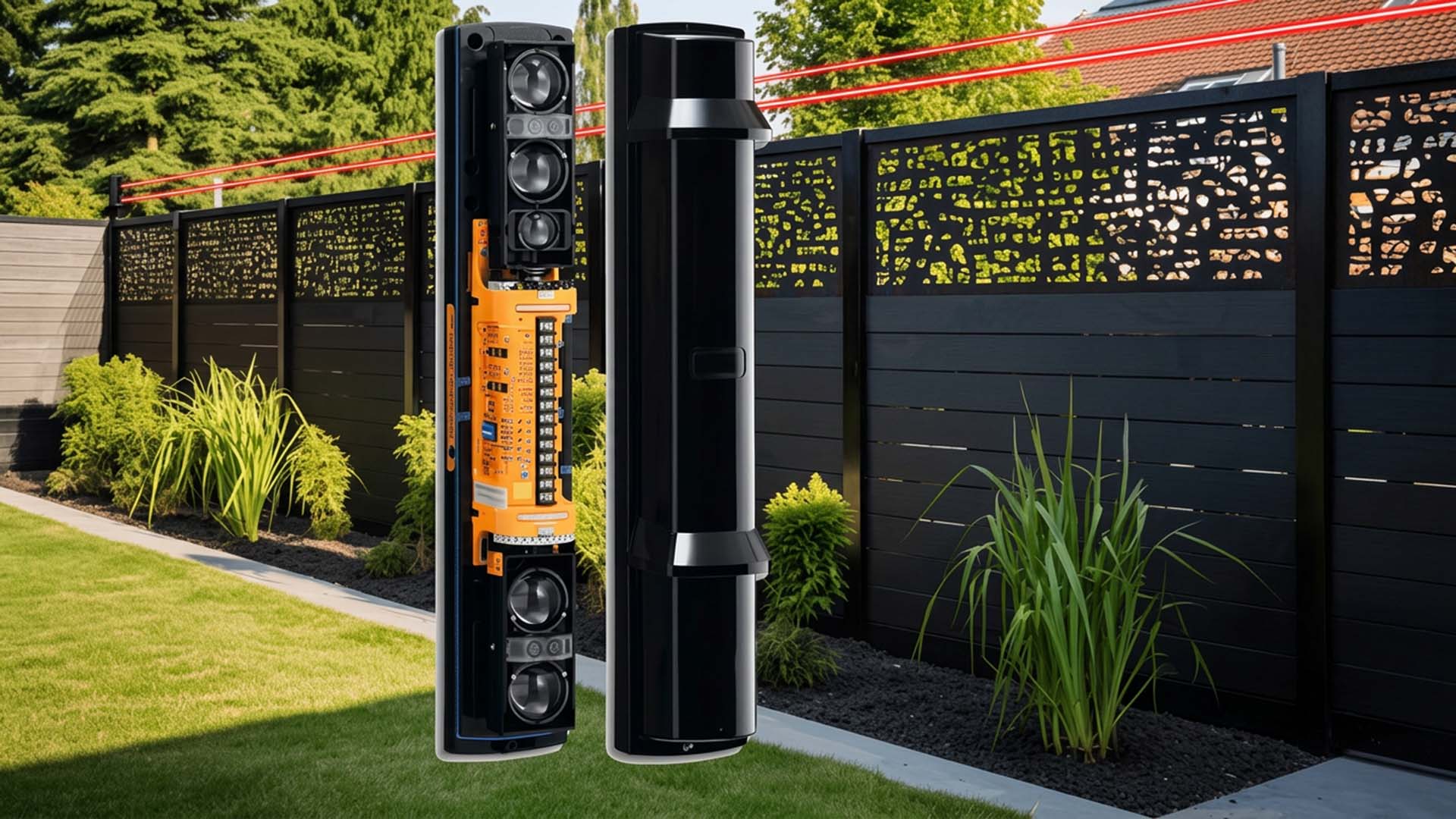
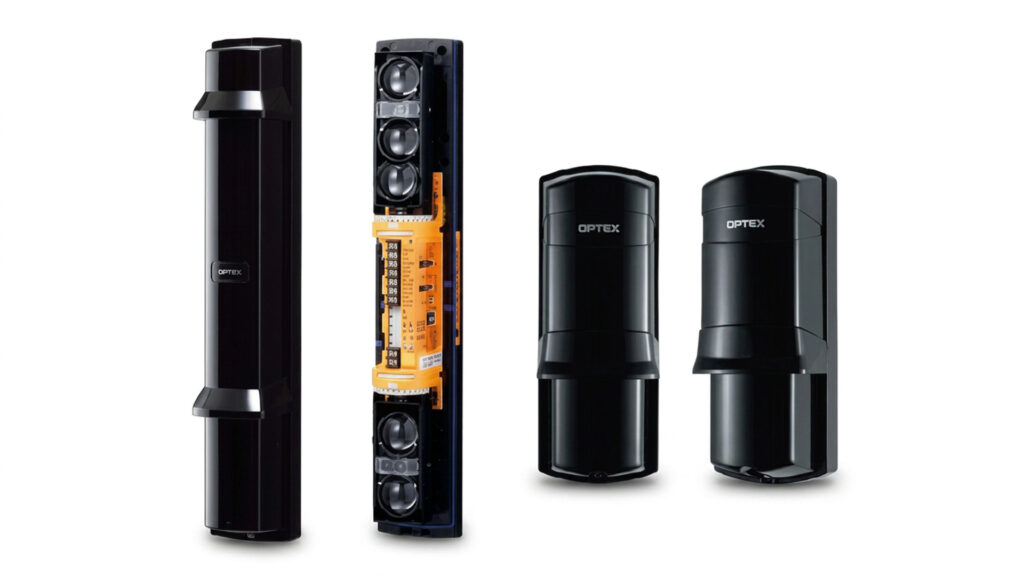
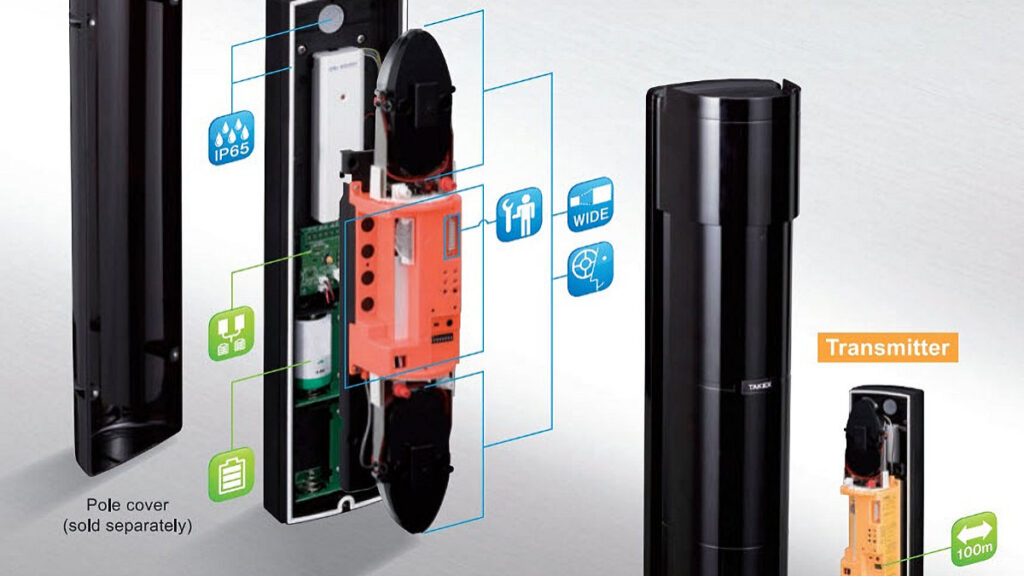
Looking at the quality end of the market there are clear benchmarks. Double modulation helps reject interference from ambient light sources and improves reliability outdoors. High-power multi-beam configurations provide margin against environmental attenuation. IP65, IP66 or IP67 rated housings, insect and water protection, and drip-proof designs reduce contamination and false alarms.
Features like alignment aids, including optical sights and wireless alignment tools, address one of the biggest installation challenges.
Lightning and surge protection is another practical requirement. Outdoor beams are exposed devices, often mounted on poles in open areas, making them vulnerable to induced surges. Integrated protection improves survivability and reduces maintenance.
Ultimately, IR beams are not a universal solution for perimeter detection, but they remain highly capable. In controlled environments, they are one of the most effective and least expensive perimeter detection technologies available. In less controlled environments, they require careful design, realistic expectation and ongoing maintenance but still proffer advantages of low cost and high catch rate.
Shop quality AIR beams
Long-Range IR Beam Spec Wish List
At 200m installers will be thinking about maintaining signal integrity and stability over distance. You are fighting attenuation, alignment drift and environmental load all at once and you need to have that in mind to ensure best performance for clients.
The starting point is beam architecture. You want quad beam configuration as a minimum, ideally with high power transmission that significantly exceeds the minimum requirement. Better units are deliberately overpowered to maintain detection margin in fog, rain and dust, not just in ideal conditions – favour quality units.
Modulation is critical. Look for double modulation or selectable modulation frequencies to reject sunlight, headlights and cross-talk between adjacent beam sets. This is non-negotiable on longer runs.
Alignment features – you want wide horizontal and vertical adjustment range (around ±20° or better), dual ring sight or optical alignment aids, an optional wireless alignment tool or voltage monitor output.
Signal management features you’ll value include auto gain control or gain lock, signal strength monitoring output and environmental diagnostic feedback – these give visibility of margin and allow proactive maintenance before nuisance alarms begin.
Response control features you’ll value include adjustable interruption time (around 50ms to 700ms range) and the ability to tune out transient events like birds or debris.
Mechanically, long range beams need to survive external applications – think IP65 or better housing, anti-condensation, defog, drip-proof designs, insect sealing and gasketed enclosures, corrosion-resistant mounts, lightning and surge protection rated to high levels (10kV+ typical) and UV resistance plastics.
Beam geometry also matters – look for wider beam spacing between upper and lower beams to reduce nuisance alarms from small objects and tight beam focus with controlled dispersion to maintain accuracy over distance. Power and efficiency are other practical considerations but while lower current draw is useful at 200m sensor performance trumps power consumption.
System integration capabilities include things like relay outputs (alarm, tamper, fault), optional bus or IP interface for diagnostics and compatibility with alarm panels, access control inputs and I/O modules feeding SMS and VMS.
Spec comparison table: 200 m long-range vs 50 m short-range active infrared beam requirements
Short Range IR Beam Wish List
At 50m priorities shift to detection zone coverage, catch rate, false alarm resistance and flexible installation. We think you still want multi-beam, but the focus is false alarm resistance rather than raw power for reach and multi-beams are great at tuning out false alarm sources by design. A dual or quad beam set is sufficient for many short-range applications, provided spacing and processing are good.
Modulation remains important, for active infrared beams in perimeter security, ideally you want double modulation to reject ambient light and basic channel selection if multiple beams are deployed. Beam shaping becomes more relevant at short range, so think wide beam spacing to ignore small objects and a stable detection zone that tolerates minor misalignments to handle drift over time.
Alignment is also important but less demanding so simpler optical sighting it acceptable if performance remains strong. You still want adjustment range, but you don’t need the same level of precision as a 200m system does.
At 50m response control and filtering features like programmable interruption time, DSP filtering of small objects like birds, leaves, insects and stable operation in environments with vegetation and human traffic are priorities.
Environmental protection is still required, including weatherproof housings and resistance to EMI and RFI. You are going to be wanting the flexibility to mount on walls, poles, fences as required and you will like value tolerance to slight movement without constant re-alignment.
Integration features for shorter range devices include relay outputs to alarm or access systems and fast alarm signalling. You’d also be thinking about power consumption, particularly if wireless was on the table – some beams include facilities for wireless.
There are alternatives to AIRs beams but none perform quite as well in specific applications for which AIRs is suited – clear perimeters, fencelines and rooftops with minimal intrusion events when the system is armed.
Perimeter sensor technology comparison matrix
| Active IR beam | Microwave | LiDAR | Fence-mounted | Buried cable | |
|---|---|---|---|---|---|
| Typical range | Up to 200 m | 100–300 m+ | Up to 200 m | Fence length | Up to 200 m |
| Weather tolerance | Moderate — fog & rain attenuate | Excellent — penetrates fog & rain | Good — some attenuation in fog | Excellent — direct contact | Excellent — unaffected |
| False alarm risk | Low when configured correctly | Medium — volumetric spill | Low — precise point cloud | Low — contact detection | Medium — ground conditions |
| Open area coverage | Excellent — line-of-sight lanes | Excellent — wide volumetric zone | Good — defined scan zone | No — fence only | Limited — ground plane only |
| Alignment sensitivity | High — exacting alignment required | Low — wide volumetric field | Low — software-defined zones | None — attached to structure | None — buried fixed |
| Cost per metre | Low | Low–medium | High | Medium | High |
| Civil works required | Minimal — post mounting | Minimal — post mounting | Minor — bracket/pole mount | Medium — fence infrastructure | Significant — trenching required |
| Classification ability | None — beam break only | None — motion only | Excellent — size & shape data | Limited — vibration pattern | Limited — pressure signature |
| Best application | Clear perimeters, fence lines, rooftops, corridors | Open areas, adverse weather sites | High-security, classification needed | Fence interaction detection | Covert high-security perimeters |
Generally speaking, microwave offers better performance in fog, rain and snow and covers longer distances with less alignment sensitivity. But because microwave is volumetric and tends to spill into adjacent areas, it can be more prone to false alarms in or near the detection zone. LiDAR is a new technology worth considering, too. Incorporating integrated optical surveillance, it’s highly capable and very flexible, but more costly per metre than AIRs.
Meanwhile, fence-mounted systems – think taut wire, fibre optic and powered fences – provide direct detection of fence interaction and strong deterrent. They are highly effective for fence protection but they don’t cover open spaces across lanes of approach as AIRs beams do. Meanwhile, buried cable systems provide covert detection but require significant civil works and are sensitive to ground conditions – solutions like leaky coax are also expensive, restricting their use to high security applications.
Finally, external PIR and dual-tech sensors are flexible and easy to deploy but are not as capable over long distances in external applications where they can be affected by environmental conditions that mean range is further limited in extremis. AIRs beams by comparison can cover long ranges, are cost-effective, simple, and reliable when deployed correctly and recommissioned as part of maintenance programs.
You can find some quality AIRs beams here and here – there’s more SEN news here.
Shop quality AIR beams
“Active Infrared Beams In Perimeter Security – Strengths, Weaknesses And Features You Want.”
FAQ’s
How do active infrared (AIR) beams work in perimeter security?
An active infrared beam system uses a transmitter that sends modulated infrared energy to a receiver across a line-of-sight path. If the beam is interrupted for a defined period, the system generates an alarm. Because an intruder has to physically cross the beam to trigger it, AIR beams provide deterministic detection with very low nuisance alarm rates when properly configured in controlled environments like fence lines, access points and defined corridors.
What causes false alarms with infrared beams, and how can they be reduced?
False alarms usually come from environmental noise (birds, insects, vegetation, debris and wind gusts) and from misalignment that weakens signal margin. Higher-quality beam sets reduce these with quad-beam configurations, wider spacing between upper and lower beams, double modulation to reject ambient light, and programmable interruption times that distinguish a brief flicker (a bird) from a sustained break (a person). Regular recommissioning also keeps alignment within tolerance.
What is the maximum range of an infrared beam detector?
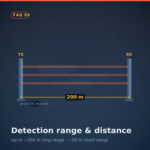
Long-range beam sets can cover up to around 200m, while shorter-range applications typically run at about 50m. However, beams installed at their maximum rated distance are more vulnerable to fog, rain and dust attenuation. Experienced installers deliberately shorten the working distance below the maximum spec to build in detection margin, then refine it once local performance data reveals any weak spots.
At what height should infrared security beams be mounted?
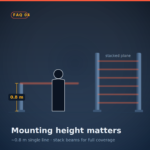
Single-line AIR beams are typically mounted around 0.8m high so the detection line reliably intersects the human body. For stronger coverage, beams are stacked vertically to form a detection plane from near ground level to several metres high, which improves resistance to crawl-through and step-over attempts. Mounting too high or too low significantly reduces detection reliability.
Are infrared beams better than microwave, LiDAR or fence-mounted sensors?
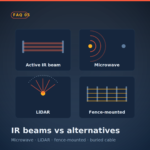
It depends on the environment. AIR beams are one of the most cost-effective and reliable options for clear perimeters, fence lines and rooftops. Microwave performs better in fog, rain and snow over longer distances but can spill into adjacent areas. LiDAR is highly flexible with integrated surveillance but costs more per metre. Fence-mounted systems excel at detecting fence interaction but don’t cover open approaches the way beams do. In practice, AIR beams are often integrated with CCTV and VMS rather than used in isolation.
Active Infrared Beams In Perimeter Security [ Active Infrared Beams In Perimeter Security ]